<?xml version="1.0" encoding="utf-8"?><feed xmlns="http://www.w3.org/2005/Atom" ><generator uri="https://jekyllrb.com/" version="3.10.0">Jekyll</generator><link href="https://de-rse.org/feed.xml" rel="self" type="application/atom+xml" /><link href="https://de-rse.org/" rel="alternate" type="text/html" /><updated>2026-07-06T11:53:35+02:00</updated><id>https://de-rse.org/feed.xml</id><title type="html">de-RSE.org</title><subtitle>Website of de-RSE e.V. - Gesellschaft für Forschungssoftware</subtitle><author><name>Stephan Druskat</name></author><entry><title type="html">de-RSE e.V. in der Research Organization Registry (ROR): 007qpef44</title><link href="https://de-rse.org/blog/2026/06/29/ROR-de.html" rel="alternate" type="text/html" title="de-RSE e.V. in der Research Organization Registry (ROR): 007qpef44" /><published>2026-06-29T00:00:00+02:00</published><updated>2026-06-29T00:00:00+02:00</updated><id>https://de-rse.org/blog/2026/06/29/ROR-de</id><content type="html" xml:base="https://de-rse.org/blog/2026/06/29/ROR-de.html"><![CDATA[<p><img src="https://raw.githubusercontent.com/ror-community/ror-logos/main/ror-icon-rgb.svg" alt="" width="250px" />de-RSE e. V.: <a href="https://ror.org/007qpef44">https://ror.org/007qpef44</a></p>

<p>Die „Research Organization Registry“, oder kurz oft einfach nur ROR, ist eine Datenbank für dauerhafte Kennungen von Einrichtungen im wissenschaftlichen Umfeld.
Diese „persistent identifier“ sollen ähnlich wie <a href="https://info.orcid.org/what-is-orcid/">ORCID</a>s, die dies für Personen tun, eindeutige Referenzen zu eben diesen Einrichtungen bereitstellen, unabhängig von ggf. gleichen oder ähnlichen Namen verschiedener Organisationen oder auch Namens- und Sprachvarianten ein und der gleichen Einrichtung.</p>

<p>Zahlreiche Verlage erlauben schon die Verwendung von RORs bei der Angabe von Personenzugehörigkeiten.
Auch in eurem Profil auf <a href="https://info.orcid.org/what-is-orcid/">ORCID</a> lassen sich entsprechende Einträge <a href="https://info.orcid.org/de/add-research-institution-identifiers-with-ror/">hinzufügen</a>.
Die Gesellschaft für Forschungssoftware hat nun ebenfalls eine solche ROR: <a href="https://ror.org/007qpef44">007qpef44</a>.
In Zukunft gibt es damit immer eine Möglichkeit, den Verein zweifelsfrei zu referenzieren.
Als Mitglied (oder Mitarbeitender) des Vereins könnt ihr sie zum Beispiel benutzen, um eure Zugehörigkeit zur Gesellschaft in Veröffentlichungen sichtbar zu machen, wenn die Arbeit im Zusammenhang mit dem Verein entstanden ist.</p>]]></content><author><name>Frank Löffler</name></author><summary type="html"><![CDATA[de-RSE e. V.: https://ror.org/007qpef44 Die „Research Organization Registry“, oder kurz oft einfach nur ROR, ist eine Datenbank für dauerhafte Kennungen von Einrichtungen im wissenschaftlichen Umfeld. Diese „persistent identifier“ sollen ähnlich wie ORCIDs, die dies für Personen tun, eindeutige Referenzen zu eben diesen Einrichtungen bereitstellen, unabhängig von ggf. gleichen oder ähnlichen Namen verschiedener Organisationen oder auch Namens- und Sprachvarianten ein und der gleichen Einrichtung. Zahlreiche Verlage erlauben schon die Verwendung von RORs bei der Angabe von Personenzugehörigkeiten. Auch in eurem Profil auf ORCID lassen sich entsprechende Einträge hinzufügen. Die Gesellschaft für Forschungssoftware hat nun ebenfalls eine solche ROR: 007qpef44. In Zukunft gibt es damit immer eine Möglichkeit, den Verein zweifelsfrei zu referenzieren. Als Mitglied (oder Mitarbeitender) des Vereins könnt ihr sie zum Beispiel benutzen, um eure Zugehörigkeit zur Gesellschaft in Veröffentlichungen sichtbar zu machen, wenn die Arbeit im Zusammenhang mit dem Verein entstanden ist.]]></summary></entry><entry><title type="html">de-RSE e.V. in the Research Organization Registry (ROR): 007qpef44</title><link href="https://de-rse.org/blog/2026/06/29/ROR-en.html" rel="alternate" type="text/html" title="de-RSE e.V. in the Research Organization Registry (ROR): 007qpef44" /><published>2026-06-29T00:00:00+02:00</published><updated>2026-06-29T00:00:00+02:00</updated><id>https://de-rse.org/blog/2026/06/29/ROR-en</id><content type="html" xml:base="https://de-rse.org/blog/2026/06/29/ROR-en.html"><![CDATA[<p><img src="https://raw.githubusercontent.com/ror-community/ror-logos/main/ror-icon-rgb.svg" alt="" width="250px" />de-RSE e. V.: <a href="https://ror.org/007qpef44">https://ror.org/007qpef44</a></p>

<p>The “Research Organisation Registry”, often referred to simply as ROR for short, is a database of persistent identifiers for organisations in the academic sector.
Similar to <a href="https://info.orcid.org/what-is-orcid/">ORCID</a>s, which serve this purpose for individuals, these “persistent identifiers” are intended to provide unique references to these organisations, regardless of potential identical or similar names of different organisations, or language or other variations of the name for the same organisation.</p>

<p>Numerous publishers already allow the use of RORs when specifying an individual’s affiliations.
You can also <a href="https://info.orcid.org/de/add-research-institution-identifiers-with-ror/">add</a> corresponding entries to your profile on <a href="https://info.orcid.org/what-is-orcid/">ORCID</a>.
The Society for Research Software in Germany now also has such a ROR: <a href="https://ror.org/007qpef44">007qpef44</a>.
This means that from now on, you have a persistent way to reference the Society.
As a member (or staff) of the Society, you can use it, for example, to indicate your affiliation with the Society in publications that somehow connect to it.</p>]]></content><author><name>Frank Löffler</name></author><summary type="html"><![CDATA[de-RSE e. V.: https://ror.org/007qpef44 The “Research Organisation Registry”, often referred to simply as ROR for short, is a database of persistent identifiers for organisations in the academic sector. Similar to ORCIDs, which serve this purpose for individuals, these “persistent identifiers” are intended to provide unique references to these organisations, regardless of potential identical or similar names of different organisations, or language or other variations of the name for the same organisation. Numerous publishers already allow the use of RORs when specifying an individual’s affiliations. You can also add corresponding entries to your profile on ORCID. The Society for Research Software in Germany now also has such a ROR: 007qpef44. This means that from now on, you have a persistent way to reference the Society. As a member (or staff) of the Society, you can use it, for example, to indicate your affiliation with the Society in publications that somehow connect to it.]]></summary></entry><entry><title type="html">Research Software Engineers in the Age of GenAI: Same Value, Changing Practice</title><link href="https://de-rse.org/blog/2026/05/28/RSEng-GenAI-workshop.html" rel="alternate" type="text/html" title="Research Software Engineers in the Age of GenAI: Same Value, Changing Practice" /><published>2026-05-28T00:00:00+02:00</published><updated>2026-05-28T00:00:00+02:00</updated><id>https://de-rse.org/blog/2026/05/28/RSEng-GenAI-workshop</id><content type="html" xml:base="https://de-rse.org/blog/2026/05/28/RSEng-GenAI-workshop.html"><![CDATA[<p><img src="/assets/img/blog/2026/2026-05-28-ReSA-GenAI_Figure-1_hu.webp" alt="How various roles are evolving in response to GenAI." width="450px" align="center" /></p>

<p>This blog post is being cross-posted by the <a href="https://www.researchsoft.org/blog/">Research Software Alliance</a> (ReSA), <a href="https://bssw.io/blog_posts">Better Scientific Software</a> (BSSw), the <a href="https://everse.software/news/">European Virtual Institute for Research Software Excellence</a> (EVERSE) and the <a href="https://www.software.ac.uk/news-and-blogs-hub">Software Sustainability Institute</a> (SSI).</p>

<ul>
  <li><em>DOI: <a href="https://doi.org/10.5281/zenodo.20320179">10.5281/zenodo.20320179</a></em></li>
  <li>Illustrations by Druskat et al., used under the Creative Commons Attribution 4.0 International License (<a href="https://creativecommons.org/licenses/by/4.0/">CC BY 4.0</a>), doi:<a href="https://doi.org/10.5281/zenodo.20050753">10.5281/zenodo.20050753</a>.</li>
</ul>

<blockquote>
  <p><strong>Research software and its creators have long played a critical role in the advancement of research worldwide. This role is changing in the age of “generative AI” (GenAI), but both the software and the people remain of key importance. Understanding these changes is essential in enabling Research Software Engineers (RSEs) to continue contributing the same high value to the research process and its outputs.</strong></p>

  <p><strong>Before GenAI, the RSE movement had learned to clearly articulate the value proposition of embedding expert software engineering in research to its stakeholders. This blog post highlights how RSEs use GenAI to increase their capacity in both software engineering and research, and visualize this evolution. While GenAI is changing - perhaps considerably - how RSEs work in practice, their value and the value of their work for research remains steady and likely to increase.</strong></p>
</blockquote>

<!--more-->

<p>Generative AI, specifically Large Language Models (LLMs) and coding agents, is rapidly changing software engineering. The practice of software engineering is shifting away from writing lines of code to specifying requirements, implementations, designs and verification strategies in higher-level abstractions, including natural language specifications, that are then enacted by an AI coding agent. This lowers the barrier to entry for producing code and reduces the development time for new solutions.</p>

<p>Generative AI is not only impacting software development in industry, but is understandably also seeing rapid adoption in academia to accelerate software development processes. Its application enables researchers to produce their own research software, including those who would not have done so previously. Software solutions, once beyond the reach of researchers lacking programming and software engineering knowledge, are now accessible with these new GenAI tools. If researchers can write more - and better - code, themselves, it begs the question: where do RSEs fit in this new paradigm?</p>

<p>In March 2026, 36 members of the research software community came together to discuss this at a workshop entitled “<a href="https://www.researchsoft.org/events/rse-ai-workshop/">Research Software Engineering in the Age of Generative AI: Building a Community Vision</a>”, held in Edinburgh, UK. The Research Software Alliance co-led this event and was supported to undertake this work as part of a Schmidt Sciences grant. Whilst the impact of GenAI on research is being discussed in many forums and publications, this workshop provided an opportunity for a range of early adopters, innovators, and RSE leads to come together to discuss how the ecosystem was changing, and to chart constructive ways to shape and support this change.</p>

<p>The workshop included multiple rounds of focused working groups, one of which discussed the value of research software engineering in the age of GenAI. This blog post is an outcome of that working group. Its authors brought together their experience as leaders of different types of RSE initiatives across the ecosystem to provide an accessible way to show both how the roles of research software personnel are evolving in line with GenAI, and how these roles remain key to enabling research impact.</p>

<p>There are costs, concerns and risks associated with the creation and use of AI models generally [<sup id="fnref:1" role="doc-noteref"><a href="#fn:1" class="footnote" rel="footnote">1</a></sup>,<sup id="fnref:2" role="doc-noteref"><a href="#fn:2" class="footnote" rel="footnote">2</a></sup>], and in a multitude of more focused areas, including skills [<sup id="fnref:3" role="doc-noteref"><a href="#fn:3" class="footnote" rel="footnote">3</a></sup>, <sup id="fnref:4" role="doc-noteref"><a href="#fn:4" class="footnote" rel="footnote">4</a></sup>, <sup id="fnref:5" role="doc-noteref"><a href="#fn:5" class="footnote" rel="footnote">5</a></sup>, <sup id="fnref:6" role="doc-noteref"><a href="#fn:6" class="footnote" rel="footnote">6</a></sup>], community culture and motivation [<sup id="fnref:7" role="doc-noteref"><a href="#fn:7" class="footnote" rel="footnote">7</a></sup>, <sup id="fnref:8" role="doc-noteref"><a href="#fn:8" class="footnote" rel="footnote">8</a></sup>], as well as equity and ethics [<sup id="fnref:9" role="doc-noteref"><a href="#fn:9" class="footnote" rel="footnote">9</a></sup>, <sup id="fnref:10" role="doc-noteref"><a href="#fn:10" class="footnote" rel="footnote">10</a></sup>, <sup id="fnref:11" role="doc-noteref"><a href="#fn:11" class="footnote" rel="footnote">11</a></sup>]. However, while many of these risks also apply to the use of GenAI in coding tasks, there are also many immediate benefits for coding [<sup id="fnref:12" role="doc-noteref"><a href="#fn:12" class="footnote" rel="footnote">12</a></sup>, <sup id="fnref:13" role="doc-noteref"><a href="#fn:13" class="footnote" rel="footnote">13</a></sup>, <sup id="fnref:14" role="doc-noteref"><a href="#fn:14" class="footnote" rel="footnote">14</a></sup>, <sup id="fnref:15" role="doc-noteref"><a href="#fn:15" class="footnote" rel="footnote">15</a></sup>]. AI tools are accelerating routine coding tasks, such as creating working scripts for data analysis, generating boilerplate code, tests and documentation, all from high-level natural language prompts. Coding agents represent a more autonomous evolution of prompt-based coding, enabling systems built around LLMs to access and operate on existing codebases to handle more complex tasks, such as refactoring or porting. They can even be used to build an entire codebase from scratch, given sufficient information such as specifications or implementation plans.</p>

<p>As software has become one of the primary research tools across all disciplines, a significant majority of scientific results rely on the quality of that software. RSEs emerged as a result: by combining professional software engineering expertise with an intimate understanding of the research discipline, partnerships between RSEs and researchers allowed software to evolve along with research, with RSEs guiding the productive application of methods and technologies and ensuring that software meets the reliability and reproducibility standards that are expected from scientific instruments. This unique position of RSEs bridging software engineering and research was often depicted in diagrams similar to Figure 1, which shows that RSEs vary in their skills and knowledge of both software engineering and research activities. It also shows RSE-adjacent roles (such as software engineer, researcher, and researcher who codes) to provide context, illustrating that RSEs have more software engineering experience than researchers, while also possessing a deeper understanding of research practices than software engineers. Diagrams like these have been very important tools in achieving (pre-GenAI) understanding of the value provided by RSEs, to the extent that RSEs are supported by national initiatives such as those in the UK, the Netherlands and Germany [<sup id="fnref:16" role="doc-noteref"><a href="#fn:16" class="footnote" rel="footnote">16</a></sup>, <sup id="fnref:17" role="doc-noteref"><a href="#fn:17" class="footnote" rel="footnote">17</a></sup>, <sup id="fnref:18" role="doc-noteref"><a href="#fn:18" class="footnote" rel="footnote">18</a></sup>].</p>

<p><br /><br /></p>

<p><img src="/assets/img/blog/2026/1_evolution_RSE_role_GenAI-RSE_role_adjacent_roles_today-compressed.png" alt="RSEs bring both software engineering and research expertise." width="600px" /><br /><br /><strong>Figure 1:</strong> <em>RSEs bring both software engineering and research expertise.</em></p>

<p><br /><br /></p>

<p>With the advent of GenAI, two questions arise: Is this partnership between RSEs and researchers still needed and still valuable? And, how do these roles change? In the age of GenAI, both researchers and RSEs have access to LLMs and coding agents to accelerate their work. Researchers are able to prototype and explore ideas faster and more freely than before. Meanwhile, RSEs are able to use these GenAI tools to greater effect and impact, due to their expertise in software engineering, particularly in requirements engineering and specification, software architecture, testing and verification, validation, performance, and long-term sustainability. This enables them to frame problems more precisely, to evaluate tradeoffs and verify internal correctness and consistency more effectively, and to better address longstanding challenges in research software. Moreover, their continued and frequent practice with these tools compounds their advantages, allowing them to better anticipate failure modes, enforce quality standards, and integrate tooling into complex, evolving research environments.</p>

<p>RSEs who maintain GenAI literacy and the ability to critically evaluate complex software stacks are especially indispensable in view of the risks associated with the increasing adoption of GenAI in research software development. In particular, when researchers use agentic coding tools without sufficient expertise and experience to write increasingly complex software, over-reliance on these tools risks generating a significant disconnect between the coder and the code. This disconnect can lead to the introduction of unintended errors and inaccuracies, and could pose serious risk to the robustness of related scientific outputs and research results. In this situation, RSEs are well positioned to provide the guidance and oversight that is necessary to ensure the safe adoption of AI in research software engineering.</p>

<p>Taken together, the value of an RSE remains significant, as the RSE role evolves to integrate expert knowledge in the application of GenAI for software engineering in research contexts. This viewpoint is similarly articulated in the <a href="https://github.com/Academic-Data-Science-Alliance/rse-ai-position-statement/blob/main/RSE-AI-Final_Statement.md">Position Statement on Generative AI in the RSE Workplace</a><sup id="fnref:19" role="doc-noteref"><a href="#fn:19" class="footnote" rel="footnote">19</a></sup>, which is led by US-RSE and the Alliance for Data Science and AI. The Edinburgh workshop built upon this position statement, and it is also being shared in other conversations [<sup id="fnref:20" role="doc-noteref"><a href="#fn:20" class="footnote" rel="footnote">20</a></sup>, <sup id="fnref:21" role="doc-noteref"><a href="#fn:21" class="footnote" rel="footnote">21</a></sup>]. As such, the value of RSEs in relation to researchers and other stakeholders will remain unchanged as their role as a research software professional evolves to also integrate expert knowledge in the application of GenAI in research contexts. This blog post seeks to move one step further in clearly articulating that value in a way that is easy to understand.</p>

<p>Overall, <strong>the value of the RSE role shifts upward as AI enhances it and amplifies its impact. While the practice may change and shift focus to higher levels of abstraction, including specification and verification, the value proposition remains the same</strong>. This is depicted in Figure 2, which shows how the use of GenAI enables the value of RSEs to increase along both the software engineering and research activity axes. It is critical for the research community to understand and acknowledge this increased potential for research impact, and to ensure that going forward, RSE expertise is appropriately supported, funded and integrated into research ecosystems.</p>

<p><br /><br /></p>

<p><img src="/assets/img/blog/2026/2026-05-28-ReSA-GenAI_Figure-2_hu.webp" alt="AI can enable RSEs to increase their capacity for both research and software engineering, irrespective of specializations." width="600px" /><br /><br /><strong>Figure 2:</strong> <em>AI can enable RSEs to increase their capacity for both research and software engineering, irrespective of specializations.</em></p>

<p><br /><br /></p>

<p>Figure 3 highlights the unique position of RSEs in the research ecosystem. RSEs and other roles in the research sector (software engineers, researchers who code, and researchers) all evolve in response to leveraging GenAI tools, which affects all groups along the software engineering capacity axis to varying degrees. Researchers who have not previously done any programming can now generate their own code, but for all non-RSE roles these shifts largely reinforce strengths within their established areas of expertise. For RSEs, however, this evolution plays to their dual focus on both software engineering and research, so that the effective value of RSEs and their work is amplified, as GenAI enables them to provide (even) more and better software to support (even) more and better research.</p>

<p><br /><br /></p>

<p><img src="/assets/img/blog/2026/2026-05-28-ReSA-GenAI_Figure-3_hu.webp" alt="How various roles are evolving in response to GenAI." width="600px" /><br /><br /><strong>Figure 3:</strong> <em>How various roles are evolving in response to GenAI.</em></p>

<h2 id="acknowledgements">Acknowledgements</h2>

<p>MB and DSK were supported to undertake this work as part of Schmidt Sciences grant G-25-69965.</p>

<h2 id="author-biographies">Author biographies</h2>

<ul>
  <li>
    <p><a href="https://www.linkedin.com/in/michelledbarker/">Michelle Barker</a> is Director of the Research Software Alliance and has extensive expertise in open science, the research software community, digital skills, and digital research infrastructure. As a sociologist, Michelle is passionate about building collaborative partnerships to achieve system change. She is a former Director of the Australian Research Data Commons, where she led the national research software infrastructure investment program.</p>
  </li>
  <li>
    <p><a href="https://github.com/cosden">Ian Cosden</a> is the Senior Director of Research Software Engineering at Princeton University. He leads a team of research software engineers who complement multiple traditional academic research groups by offering embedded, long-term software development expertise. He spearheaded the formation of the RSE group in 2016 and has grown the group from an initial size of two FTEs, to a total of 37 FTEs as of May 2026. Ian is the current and founding chair of the steering committee for the United States Research Software Engineer (US-RSE) Association. Additionally, he is the principal investigator for Innovative Training Enabled by a Research Software Engineering Community of Trainers (INTERSECT), an NSF-funded project to develop and deliver RSE-led training events for current researchers interested in careers in research software engineering.</p>
  </li>
  <li>
    <p><a href="https://sdruskat.net">Stephan Druskat</a> is a (Research) Software Engineering Researcher based in Berlin. His research focuses on requirements, constraints, policies and practices of software engineering in academic research contexts, such as software publication, citation and sustainability, as well as software metadata and software supply chains. He is a Fellow of the Software Sustainability Institute, co-founder of the Society for Research Software in Germany (de-RSE), and lead of the Citation File Format project.</p>
  </li>
  <li>
    <p><a href="https://github.com/CunliangGeng">Cunliang Geng</a> is a Senior Research Software Engineer at the <a href="https://www.esciencecenter.nl/">Netherlands eScience Center</a>, where he currently leads a study group exploring the use and impact of AI in research software engineering. He is passionate about the intersection of scientific research and software engineering, and has more than seven years of experience developing open source software and building machine learning systems for life sciences research. He holds a PhD in computational structural biology from Utrecht University. Cunliang is also a Carpentries instructor and has delivered training for researchers on topics including deep learning, parallel programming, Docker containers, and related research computing skills.</p>
  </li>
  <li>
    <p><a href="https://github.com/hainesr">Robert Haines</a> is Director of Research IT and an Honorary Lecturer at the University of Manchester, and a Fellow of the Software Sustainability Institute. He is one of the originators of the term “Research Software Engineer”, served for six years as an elected representative of the UK RSE Association, chaired the First Conference of Research Software Engineers in 2016, and was a founding trustee of the Society of Research Software Engineering. Robert’s research interests include software engineering, software sustainability, software use in open and reproducible research, software citation and credit, and career paths for software engineers and data scientists.</p>
  </li>
  <li>
    <p><a href="https://danielskatz.org/">Daniel S. Katz</a> is Chief Scientist at the National Center for Supercomputing Applications, Research Professor in the Siebel School of Computing and Data Science, and Research Professor in the School of Information Sciences at the University of Illinois Urbana-Champaign. He works at the triple point of research software, people, and policy. He is a co-founder and current Associate Editor-in-Chief of the Journal of Open Source Software, co-founder of the US Research Software Engineer Association (US-RSE), and co-founder and steering committee chair of the Research Software Alliance (ReSA).</p>
  </li>
  <li>
    <p><a href="https://github.com/jshng-glasgow">Joseph Shingleton</a> is a Research Software Engineer at the University of Glasgow. His research explores how artificial intelligence can be safely and effectively applied to tasks in geospatial data science and research software engineering. He is the recipient of a UKRI Metascience AI Fellowship, focusing on how generative AI is shaping RSE practice and its consequences for the scientific process. He is also a Software Sustainability Institute Fellow and leads the SSI study group on responsible AI in RSE.</p>
  </li>
  <li>
    <p><a href="https://github.com/benvanwerkhoven">Ben van Werkhoven</a> is assistant professor at Leiden University, where he heads the Accelerated Computing research group, focusing on making high-performance computing more energy-efficient and sustainable. He holds a PhD from VU Amsterdam on GPU-accelerated scientific computing (2014) and spent nearly a decade at the Netherlands eScience Center before joining Leiden in 2023. With over 15 years of GPU programming and optimization experience, Ben has worked on scientific applications ranging from microscopy and climate modeling to radio astronomy. He is also a co-founder of the Netherlands Research Software Engineers community (NL-RSE), advocating for the recognition of research software engineering as a professional discipline. At Leiden, he teaches High Performance Computing and Multiprocessor Programming, and serves as principal investigator on several research projects. He participates in major European and national consortia, including CORTEX and ESiWACE, advancing large-scale computing infrastructure for science.</p>
  </li>
</ul>

<h2 id="references">References</h2>

<div class="footnotes" role="doc-endnotes">
  <ol>
    <li id="fn:1" role="doc-endnote">
      <p>M. Hosseini, S. P. J. M. Horbach, K. L. Holmes, and T. Ross-Hellauer, ‘Open Science at the Generative AI Turn: An Exploratory Analysis of Challenges and Opportunities’, May 24, 2024, <em>SocArXiv</em>. doi: <a href="https://doi.org/10.31235/osf.io/zns7g">10.31235/osf.io/zns7g</a> <a href="#fnref:1" class="reversefootnote" role="doc-backlink">&#8617;</a></p>
    </li>
    <li id="fn:2" role="doc-endnote">
      <p>G. O’Brien, ‘Threats to scientific software from over-reliance on AI code assistants’, <em>Nat Comput Sci</em>, vol. 5, no. 9, pp. 701–703, Jul. 2025, doi: <a href="https://doi.org/10.1038/s43588-025-00845-2">10.1038/s43588-025-00845-2</a> <a href="#fnref:2" class="reversefootnote" role="doc-backlink">&#8617;</a></p>
    </li>
    <li id="fn:3" role="doc-endnote">
      <p>S. Andleeb, B. Kantorski, and J. C. Carver, ‘ChatGPT in Introductory Programming: Counterbalanced Evaluation of Code Quality, Conceptual Learning, and Student Perceptions’, 2025, <em>arXiv</em>. doi: <a href="https://doi.org/10.48550/ARXIV.2510.00946">10.48550/ARXIV.2510.00946</a> <a href="#fnref:3" class="reversefootnote" role="doc-backlink">&#8617;</a></p>
    </li>
    <li id="fn:4" role="doc-endnote">
      <p>G. O’Brien, A. Parker, N. Eisty, and J. Carver, ‘A survey of generative AI adoption and perceived productivity among scientists who program’, Apr. 09, 2026, <em>arXiv</em>: arXiv:2512.19644. doi: <a href="https://doi.org/10.48550/arXiv.2512.19644">10.48550/arXiv.2512.19644</a> <a href="#fnref:4" class="reversefootnote" role="doc-backlink">&#8617;</a></p>
    </li>
    <li id="fn:5" role="doc-endnote">
      <p>SAPEA, ‘Successful and timely uptake of artificial intelligence in science in the EU: evidence review report’, SAPEA, Apr. 2024. doi: <a href="https://doi.org/10.5281/ZENODO.10977676">10.5281/ZENODO.10977676</a> <a href="#fnref:5" class="reversefootnote" role="doc-backlink">&#8617;</a></p>
    </li>
    <li id="fn:6" role="doc-endnote">
      <p>M.-A. Storey, ‘From Technical Debt to Cognitive and Intent Debt: Rethinking Software Health in the Age of AI’, Apr. 06, 2026, <em>arXiv</em>: arXiv:2603.22106. doi: <a href="https://doi.org/10.48550/arXiv.2603.22106">10.48550/arXiv.2603.22106</a> <a href="#fnref:6" class="reversefootnote" role="doc-backlink">&#8617;</a></p>
    </li>
    <li id="fn:7" role="doc-endnote">
      <p>R. Choudhuri, D. Liu, I. Steinmacher, M. Gerosa, and A. Sarma, ‘How Far Are We? The Triumphs and Trials of Generative AI in Learning Software Engineering’, in <em>Proceedings of the IEEE/ACM 46th International Conference on Software Engineering</em>, Lisbon Portugal: ACM, Apr. 2024, pp. 1–13. doi: <a href="https://doi.org/10.1145/3597503.3639201">10.1145/3597503.3639201</a> <a href="#fnref:7" class="reversefootnote" role="doc-backlink">&#8617;</a></p>
    </li>
    <li id="fn:8" role="doc-endnote">
      <p>M. Koren, G. Békés, J. Hinz, and A. Lohmann, ‘Vibe Coding Kills Open Source’, Jan. 21, 2026, <em>arXiv</em>: arXiv:2601.15494. doi: <a href="https://doi.org/10.48550/arXiv.2601.15494">10.48550/arXiv.2601.15494</a> <a href="#fnref:8" class="reversefootnote" role="doc-backlink">&#8617;</a></p>
    </li>
    <li id="fn:9" role="doc-endnote">
      <p>S. A. Besser, E. A. Jensen, and D. S. Katz, ‘How generative AI is shaping research software development and maintenance at a research-intensive university’, <em>Open Res Europe</em>, vol. 6, p. 56, Feb. 2026, doi: <a href="https://doi.org/10.12688/openreseurope.22009.1">10.12688/openreseurope.22009.1</a> <a href="#fnref:9" class="reversefootnote" role="doc-backlink">&#8617;</a></p>
    </li>
    <li id="fn:10" role="doc-endnote">
      <p>D. R. Newman-Griffis, ‘AI thinking and the enterprise of science’, Jun. 25, 2023, <em>Open Science Framework</em>. doi: <a href="https://doi.org/10.31219/osf.io/wb83e">10.31219/osf.io/wb83e</a> <a href="#fnref:10" class="reversefootnote" role="doc-backlink">&#8617;</a></p>
    </li>
    <li id="fn:11" role="doc-endnote">
      <p>D. Salah, ‘Invisible Risks, Visible Code: A Vision for Understanding Ethical Debt in AI-Based Coding’, in <em>2025 ACM/IEEE International Symposium on Empirical Software Engineering and Measurement (ESEM)</em>, Honolulu, HI, USA: IEEE, Oct. 2025, pp. 442–446. doi: <a href="https://doi.org/10.1109/ESEM64174.2025.00074">10.1109/ESEM64174.2025.00074</a> <a href="#fnref:11" class="reversefootnote" role="doc-backlink">&#8617;</a></p>
    </li>
    <li id="fn:12" role="doc-endnote">
      <p>E. W. Bridgeford <em>et al.</em>, ‘Ten Simple Rules for AI-Assisted Coding in Science’, Oct. 31, 2025, <em>arXiv</em>: arXiv:2510.22254. doi: <a href="https://doi.org/10.48550/arXiv.2510.22254">10.48550/arXiv.2510.22254</a> <a href="#fnref:12" class="reversefootnote" role="doc-backlink">&#8617;</a></p>
    </li>
    <li id="fn:13" role="doc-endnote">
      <p>L. C. McInnes <em>et al.</em>, ‘Report of the 2025 Workshop on Next-Generation Ecosystems for Scientific Computing: Harnessing Community, Software, and AI for Cross-Disciplinary Team Science’, 2025, <em>arXiv</em>. doi: <a href="https://doi.org/10.48550/ARXIV.2510.03413">10.48550/ARXIV.2510.03413</a> <a href="#fnref:13" class="reversefootnote" role="doc-backlink">&#8617;</a></p>
    </li>
    <li id="fn:14" role="doc-endnote">
      <p>L. Nordling, ‘How ChatGPT is transforming the postdoc experience’, <em>Nature</em>, vol. 622, no. 7983, pp. 655–657, Oct. 2023, doi: <a href="https://doi.org/10.1038/d41586-023-03235-8">10.1038/d41586-023-03235-8</a> <a href="#fnref:14" class="reversefootnote" role="doc-backlink">&#8617;</a></p>
    </li>
    <li id="fn:15" role="doc-endnote">
      <p>G. O’Brien, ‘How Scientists Use Large Language Models to Program’, in <em>Proceedings of the 2025 CHI Conference on Human Factors in Computing Systems</em>, Yokohama Japan: ACM, Apr. 2025, pp. 1–16. doi: <a href="https://doi.org/10.1145/3706598.3713668">10.1145/3706598.3713668</a> <a href="#fnref:15" class="reversefootnote" role="doc-backlink">&#8617;</a></p>
    </li>
    <li id="fn:16" role="doc-endnote">
      <p>M. Barker <em>et al.</em>, ‘Software and skills for research computing in the UK’, Zenodo, Jan. 2024. doi: <a href="https://doi.org/10.5281/ZENODO.10473186">10.5281/ZENODO.10473186</a> <a href="#fnref:16" class="reversefootnote" role="doc-backlink">&#8617;</a></p>
    </li>
    <li id="fn:17" role="doc-endnote">
      <p>D. Kempf <em>et al.</em>, ‘Establishing central Research Software Engineering units in German research institutions’, 2025, [Online]. Available: <a href="https://de-rse.org/2023\_paper-RSE-groups/paper.pdf">https://de-rse.org/2023\_paper-RSE-groups/paper.pdf</a> <a href="#fnref:17" class="reversefootnote" role="doc-backlink">&#8617;</a></p>
    </li>
    <li id="fn:18" role="doc-endnote">
      <p>LCRDM, ‘Professionalizing the role of Research Software Engineers in the Netherlands’, Zenodo, Mar. 2025. doi: <a href="https://doi.org/10.5281/ZENODO.15019998">10.5281/ZENODO.15019998</a> <a href="#fnref:18" class="reversefootnote" role="doc-backlink">&#8617;</a></p>
    </li>
    <li id="fn:19" role="doc-endnote">
      <p>ADSA and US-RSE, ‘Position Statement on Generative AI in the RSE Workplace’. Accessed: Apr. 28, 2026. [Online]. Available: <a href="https://github.com/Academic-Data-Science-Alliance/rse-ai-position-statement/blob/main/RSE-AI-Final\_Statement.md">https://github.com/Academic-Data-Science-Alliance/rse-ai-position-statement/blob/main/RSE-AI-Final\_Statement.md</a> <a href="#fnref:19" class="reversefootnote" role="doc-backlink">&#8617;</a></p>
    </li>
    <li id="fn:20" role="doc-endnote">
      <p>S. Gesing, ‘RSEs 2035: Surviving or Thriving in the Age of AI’, in <em>2025 IEEE International Conference on eScience (eScience)</em>, Chicago, IL, USA: IEEE, Sep. 2025, pp. 381–382. doi: <a href="https://doi.org/10.1109/eScience65000.2025.00081">10.1109/eScience65000.2025.00081</a> <a href="#fnref:20" class="reversefootnote" role="doc-backlink">&#8617;</a></p>
    </li>
    <li id="fn:21" role="doc-endnote">
      <p>P. Leather, D. Silver, and S. Frezza, ‘Software engineering role archetypes’, presented at the IEEE SWEBOK Summit 2026, Apr. 2026. [Online]. Available: <a href="https://conf.researchr.org/details/icse-2026/swebok-2026/5/Talk-Software-engineering-role-archetypes-mapping-knowledge-skills-and-competenci">https://conf.researchr.org/details/icse-2026/swebok-2026/5/Talk-Software-engineering-role-archetypes-mapping-knowledge-skills-and-competenci</a> <a href="#fnref:21" class="reversefootnote" role="doc-backlink">&#8617;</a></p>
    </li>
  </ol>
</div>]]></content><author><name>Stephan Druskat, Michelle Barker, Ian Cosden, Cunliang Geng, Robert Haines, Daniel S. Katz, Joseph Shingleton, Ben van Werkhoven</name></author><summary type="html"><![CDATA[This blog post is being cross-posted by the Research Software Alliance (ReSA), Better Scientific Software (BSSw), the European Virtual Institute for Research Software Excellence (EVERSE) and the Software Sustainability Institute (SSI). DOI: 10.5281/zenodo.20320179 Illustrations by Druskat et al., used under the Creative Commons Attribution 4.0 International License (CC BY 4.0), doi:10.5281/zenodo.20050753. Research software and its creators have long played a critical role in the advancement of research worldwide. This role is changing in the age of “generative AI” (GenAI), but both the software and the people remain of key importance. Understanding these changes is essential in enabling Research Software Engineers (RSEs) to continue contributing the same high value to the research process and its outputs. Before GenAI, the RSE movement had learned to clearly articulate the value proposition of embedding expert software engineering in research to its stakeholders. This blog post highlights how RSEs use GenAI to increase their capacity in both software engineering and research, and visualize this evolution. While GenAI is changing - perhaps considerably - how RSEs work in practice, their value and the value of their work for research remains steady and likely to increase.]]></summary></entry><entry><title type="html">6. Konferenz für Forschungssoftwareentwicklung in Deutschland, Stuttgart, 03.-05.03.2026</title><link href="https://de-rse.org/blog/2026/03/27/deRSE26-report-de.html" rel="alternate" type="text/html" title="6. Konferenz für Forschungssoftwareentwicklung in Deutschland, Stuttgart, 03.-05.03.2026" /><published>2026-03-27T00:00:00+01:00</published><updated>2026-03-27T00:00:00+01:00</updated><id>https://de-rse.org/blog/2026/03/27/deRSE26-report-de</id><content type="html" xml:base="https://de-rse.org/blog/2026/03/27/deRSE26-report-de.html"><![CDATA[<p><img src="/assets/img/blog/2026/derse26_group_raised_arms-scaleddown.jpg" alt="" width="750px" />
<br />(<a href="https://raw.githubusercontent.com/DE-RSE/materials/master/photos/2026/group/derse26_group_raised_arms.jpg">Bild</a>: <a href="https://orcid.org/0000-0002-9428-4328">Adam Pagan</a>, CC-BY-4.0 Lizenz)</p>

<p>Die 6. Konferenz für Forschungssoftwareentwicklung in Deutschland, <a href="https://events.hifis.net/event/2945/">deRSE26</a>, ist an der Universität Stuttgart erfolgreich zu Ende gegangen. Die dreitägige Konferenz brachte mehr als 280 Teilnehmende aus Universitäten und Forschungseinrichtungen aus ganz Deutschland und darüber hinaus zusammen. Ihr ging der erste <a href="https://www.iws.uni-stuttgart.de/en/lh2/conferences-seminars-workshops/research-software-day/">Stuttgarter Tag der Forschungssoftware</a> voraus.</p>

<p>Die deRSE26 fand vom 3. bis 5. März 2026 auf dem Vaihinger Campus der <a href="https://www.uni-stuttgart.de/">Universität Stuttgart</a> statt. Die Veranstaltung diente als Forum für Personen, die Forschungssoftware in allen wissenschaftlichen Disziplinen entwickeln, pflegen und nutzen.</p>

<p>Das <a href="https://events.hifis.net/event/2945/timetable/#20260303">Programm</a> umfasste rund 90 Poster sowie 100 Vorträge, Workshops und andere interaktive Formate in bis zu fünf parallelen Programmsträngen.  Die Beiträge behandelten Themen wie Software Craftsmanship, Emerging Computing &amp; Infrastructure, Open Science &amp; Collaboration, Data Analysis &amp; AI, und Community, Policy &amp; Career Development.</p>

<p>Die Teilnehmenden deckten ein breites Spektrum an Fachgebieten ab, darunter Ingenieurswissenschaften, Natur- und Lebenswissenschaften, Geisteswissenschaften sowie Sozialwissenschaften. Im Mittelpunkt der Konferenz standen Community Building und Zusammenarbeit über Fachgrenzen, Institutionen, Geschlechter und Karrierestufen hinweg.</p>

<p>Zu den Höhepunkten des Konferenzprogramms gehörten zwei Plenarvorträge und eine Podiumsdiskussion. In seinem Plenarvortrag sprach <a href="https://www.math.colostate.edu/~bangerth/">Wolfgang Bangerth</a> von der Colorado State University über die Herausforderungen bei der Entwicklung zuverlässiger, skalierbarer Simulationssoftware in komplexen Anwendungsbereichen. Er hob hervor, wie systematisches Software-Engineering, langfristige Community-Entwicklung und offene Zusammenarbeit es ermöglichen, dass fortschrittliche numerische Methoden in der Praxis eingesetzt werden. <a href="https://events.hifis.net/event/2945/contributions/20732/">Der Vortrag</a> veranschaulichte, wie sich Forschungssoftware über Jahrzehnte hinweg weiterentwickeln kann, ohne dabei an Wartbarkeit und Überprüfbarkeit einzubüßen.</p>

<p><a href="https://fr.linkedin.com/in/morane-gruenpeter-81008232">Morane Gruenpeters</a> Plenarvortrag konzentrierte sich auf die Nachhaltigkeit und Governance von Forschungssoftware im weiteren Ökosystem der Open Science. Sie erörterte, wie Praktiken wie klare Lizenzierung, persistente Identifikatoren und strukturierte Metadaten dazu beitragen, Software auffindbar, zugänglich, interoperabel und wiederverwendbar zu machen. <a href="https://doi.org/10.5281/zenodo.18848442">In ihrem Vortrag</a> betonte sie, dass verlässliche Rahmenbedingungen und Community-Standards unerlässlich sind, um die langfristige Aufbewahrung und Anerkennung von Forschungssoftware-Ergebnissen zu gewährleisten.</p>

<p>Die <a href="https://events.hifis.net/event/2945/contributions/21220/">Podiumsdiskussion</a> befasste sich mit der zukünftigen Strukturierung des Forschungssoftware-Ökosystems in Deutschland. Die Podiumsrunde brachte Perspektiven aus Forschung, Infrastruktur und Politik zusammen, um über Anerkennung, Finanzierungsmodelle und Karrierewege für Forschungssoftwareentwickelnde zu diskutieren. Die Diskussion beleuchtete, wie Institutionen und Förderorganisationen Software besser als primäres Forschungsergebnis anerkennen können, und löste während der gesamten Konferenz intensive Folgegespräche unter den Teilnehmenden aus.</p>

<p>„Die hohe Teilnehmendenzahl bei der deRSE26 zeigt, dass Forschungssoftwareentwicklung fest als Kernkomponente der modernen Wissenschaft etabliert ist“, sagt <a href="https://www.iws.uni-stuttgart.de/en/institute/team/Flemisch-00002/">Bernd Flemisch</a>, der Konferenz-Chair. „Wir beobachten eine wachsende Anerkennung für die Menschen, Prozesse und Infrastrukturen, die zuverlässige, wiederverwendbare wissenschaftliche Software ermöglichen.“</p>

<p>Die <a href="https://events.hifis.net/event/2945/page/854-organizers">Veranstaltenden</a> kündigten zudem an, einen Tagungsband zu veröffentlichen. <a href="https://events.hifis.net/event/2945/page/848-conference-proceedings">Autor*innen sind eingeladen</a>, erweiterte Versionen ihrer Beiträge für einen speziellen Open-Access-Band in der Zeitschrift ECEASST einzureichen.</p>

<p>Die deRSE26 setzte die Reihe der Konferenzen zur Forschungssoftwareentwicklung in Deutschland fort, die von <a href="https://de-rse.org/">de-RSE e.V. - Gesellschaft für Forschungssoftware</a> ins Leben gerufen wurde. Die Veranstaltung unterstrich die Bedeutung nationaler und internationaler Vernetzung für die Förderung der beruflichen Anerkennung, der Karrierewege und der Ausbildungsmöglichkeiten für Research Software Engineers (RSEs).</p>

<p>Das Organisationskomitee dankt allen Mitwirkenden, Volunteers und lokalen Helfenden, deren Einsatz die Konferenz ermöglicht und zu einem Erfolg gemacht hat. Die finanzielle Unterstützung durch das NFDI-Konsortium <a href="https://nfdi4ing.de/">NFDI4ING</a>, die Exzellenzcluster <a href="https://www.simtech.uni-stuttgart.de/">SimTech</a>, <a href="https://www.intcdc.uni-stuttgart.de/">IntCDC</a> und [ctd.qmat] (https://www.ctdqmat.de/), sowie die Sonderforschungsbereiche <a href="https://www.sfb1667.uni-stuttgart.de/">ATLAS</a> und <a href="https://www.sfb1313.uni-stuttgart.de/">SFB 1313</a> wird dankbar anerkannt.</p>

<p>Die Planungen für die nächste Ausgabe der Konferenz für Forschungssoftwareentwicklung in Deutschland sind bereits im Gange; weitere Einzelheiten werden auf der <a href="https://de-rse.org/">de-RSE-Webseite</a> bekannt gegeben. Diese Konferenzen werden größtenteils von der Community organisiert, und alle Unterstützenden sind herzlich willkommen!</p>]]></content><author><name>Bernd Flemisch, Inga Ulusoy</name></author><summary type="html"><![CDATA[(Bild: Adam Pagan, CC-BY-4.0 Lizenz) Die 6. Konferenz für Forschungssoftwareentwicklung in Deutschland, deRSE26, ist an der Universität Stuttgart erfolgreich zu Ende gegangen. Die dreitägige Konferenz brachte mehr als 280 Teilnehmende aus Universitäten und Forschungseinrichtungen aus ganz Deutschland und darüber hinaus zusammen. Ihr ging der erste Stuttgarter Tag der Forschungssoftware voraus. Die deRSE26 fand vom 3. bis 5. März 2026 auf dem Vaihinger Campus der Universität Stuttgart statt. Die Veranstaltung diente als Forum für Personen, die Forschungssoftware in allen wissenschaftlichen Disziplinen entwickeln, pflegen und nutzen. Das Programm umfasste rund 90 Poster sowie 100 Vorträge, Workshops und andere interaktive Formate in bis zu fünf parallelen Programmsträngen. Die Beiträge behandelten Themen wie Software Craftsmanship, Emerging Computing &amp; Infrastructure, Open Science &amp; Collaboration, Data Analysis &amp; AI, und Community, Policy &amp; Career Development. Die Teilnehmenden deckten ein breites Spektrum an Fachgebieten ab, darunter Ingenieurswissenschaften, Natur- und Lebenswissenschaften, Geisteswissenschaften sowie Sozialwissenschaften. Im Mittelpunkt der Konferenz standen Community Building und Zusammenarbeit über Fachgrenzen, Institutionen, Geschlechter und Karrierestufen hinweg. Zu den Höhepunkten des Konferenzprogramms gehörten zwei Plenarvorträge und eine Podiumsdiskussion. In seinem Plenarvortrag sprach Wolfgang Bangerth von der Colorado State University über die Herausforderungen bei der Entwicklung zuverlässiger, skalierbarer Simulationssoftware in komplexen Anwendungsbereichen. Er hob hervor, wie systematisches Software-Engineering, langfristige Community-Entwicklung und offene Zusammenarbeit es ermöglichen, dass fortschrittliche numerische Methoden in der Praxis eingesetzt werden. Der Vortrag veranschaulichte, wie sich Forschungssoftware über Jahrzehnte hinweg weiterentwickeln kann, ohne dabei an Wartbarkeit und Überprüfbarkeit einzubüßen. Morane Gruenpeters Plenarvortrag konzentrierte sich auf die Nachhaltigkeit und Governance von Forschungssoftware im weiteren Ökosystem der Open Science. Sie erörterte, wie Praktiken wie klare Lizenzierung, persistente Identifikatoren und strukturierte Metadaten dazu beitragen, Software auffindbar, zugänglich, interoperabel und wiederverwendbar zu machen. In ihrem Vortrag betonte sie, dass verlässliche Rahmenbedingungen und Community-Standards unerlässlich sind, um die langfristige Aufbewahrung und Anerkennung von Forschungssoftware-Ergebnissen zu gewährleisten. Die Podiumsdiskussion befasste sich mit der zukünftigen Strukturierung des Forschungssoftware-Ökosystems in Deutschland. Die Podiumsrunde brachte Perspektiven aus Forschung, Infrastruktur und Politik zusammen, um über Anerkennung, Finanzierungsmodelle und Karrierewege für Forschungssoftwareentwickelnde zu diskutieren. Die Diskussion beleuchtete, wie Institutionen und Förderorganisationen Software besser als primäres Forschungsergebnis anerkennen können, und löste während der gesamten Konferenz intensive Folgegespräche unter den Teilnehmenden aus. „Die hohe Teilnehmendenzahl bei der deRSE26 zeigt, dass Forschungssoftwareentwicklung fest als Kernkomponente der modernen Wissenschaft etabliert ist“, sagt Bernd Flemisch, der Konferenz-Chair. „Wir beobachten eine wachsende Anerkennung für die Menschen, Prozesse und Infrastrukturen, die zuverlässige, wiederverwendbare wissenschaftliche Software ermöglichen.“ Die Veranstaltenden kündigten zudem an, einen Tagungsband zu veröffentlichen. Autor*innen sind eingeladen, erweiterte Versionen ihrer Beiträge für einen speziellen Open-Access-Band in der Zeitschrift ECEASST einzureichen. Die deRSE26 setzte die Reihe der Konferenzen zur Forschungssoftwareentwicklung in Deutschland fort, die von de-RSE e.V. - Gesellschaft für Forschungssoftware ins Leben gerufen wurde. Die Veranstaltung unterstrich die Bedeutung nationaler und internationaler Vernetzung für die Förderung der beruflichen Anerkennung, der Karrierewege und der Ausbildungsmöglichkeiten für Research Software Engineers (RSEs). Das Organisationskomitee dankt allen Mitwirkenden, Volunteers und lokalen Helfenden, deren Einsatz die Konferenz ermöglicht und zu einem Erfolg gemacht hat. Die finanzielle Unterstützung durch das NFDI-Konsortium NFDI4ING, die Exzellenzcluster SimTech, IntCDC und [ctd.qmat] (https://www.ctdqmat.de/), sowie die Sonderforschungsbereiche ATLAS und SFB 1313 wird dankbar anerkannt. Die Planungen für die nächste Ausgabe der Konferenz für Forschungssoftwareentwicklung in Deutschland sind bereits im Gange; weitere Einzelheiten werden auf der de-RSE-Webseite bekannt gegeben. Diese Konferenzen werden größtenteils von der Community organisiert, und alle Unterstützenden sind herzlich willkommen!]]></summary></entry><entry><title type="html">6th Conference for Research Software Engineering in Germany, Stuttgart, 03.-05.03.2026</title><link href="https://de-rse.org/blog/2026/03/27/deRSE26-report.html" rel="alternate" type="text/html" title="6th Conference for Research Software Engineering in Germany, Stuttgart, 03.-05.03.2026" /><published>2026-03-27T00:00:00+01:00</published><updated>2026-03-27T00:00:00+01:00</updated><id>https://de-rse.org/blog/2026/03/27/deRSE26-report</id><content type="html" xml:base="https://de-rse.org/blog/2026/03/27/deRSE26-report.html"><![CDATA[<p><img src="/assets/img/blog/2026/derse26_group_raised_arms-scaleddown.jpg" alt="" width="750px" />
<br />(<a href="https://raw.githubusercontent.com/DE-RSE/materials/master/photos/2026/group/derse26_group_raised_arms.jpg">Picture</a>: By <a href="https://orcid.org/0000-0002-9428-4328">Adam Pagan</a>, CC-BY-4.0 License)</p>

<p>The 6th Conference for Research Software Engineering in Germany, <a href="https://events.hifis.net/event/2945/">deRSE26</a>,has successfully concluded at the University of Stuttgart. The three-day conference brought together more than 280 participants from universities and research institutions across Germany and beyond. It was preceded by the first <a href="https://www.iws.uni-stuttgart.de/en/lh2/conferences-seminars-workshops/research-software-day/">Stuttgart Research Software Day</a>.</p>

<p>deRSE26 took place from March 3 to 5, 2026, on the Vaihingen campus of the <a href="https://www.uni-stuttgart.de/">University of Stuttgart</a>.  The event served as a national forum for people who develop, maintain, and use research software in all scientific disciplines.</p>

<p>The <a href="https://events.hifis.net/event/2945/timetable/#20260303">program</a> featured around 90 posters and 100 talks, workshops, and interactive sessions in up to five parallel tracks.  Contributions covered topics such as research software craftsmanship, emerging computing &amp; infrastructure, Open Science &amp; collaboration, data analysis &amp; AI, community, policy &amp; career development, as well as cross-disciplinary advancements.</p>

<p>Speakers and attendees represented a broad spectrum of domains, including engineering, natural and life sciences, humanities, and social sciences.  The conference emphasized openness, community building, and collaboration across disciplines, institutions, genders, and career stages.</p>

<p>Highlights of the conference program included two plenary talks and a podium discussion. In his plenary, <a href="https://www.math.colostate.edu/~bangerth/">Wolfgang Bangerth</a> from Colorado State University addressed the challenges of building reliable, scalable simulation software in complex application domains. He highlighted how systematic software engineering, long-term community development, and open collaboration enable advanced numerical methods to be used and trusted in practice. <a href="(https://events.hifis.net/event/2945/contributions/20732/)">The talk</a> illustrated how research software can evolve over decades while remaining maintainable and verifiable.</p>

<p><a href="https://fr.linkedin.com/in/morane-gruenpeter-81008232">Morane Gruenpeter’s</a> plenary focused on the sustainability and governance of research software in the broader open science ecosystem. She discussed how practices such as clear licensing, persistent identifiers, and structured metadata help make software findable, accessible, interoperable, and reusable. <a href="https://doi.org/10.5281/zenodo.18848442">Her talk</a> emphasized that robust policy frameworks and community standards are essential to secure long-term preservation and recognition of research software outputs.</p>

<p>The <a href="https://events.hifis.net/event/2945/contributions/21220/">podium discussion</a> targeted the future structuring of the research software ecosystem in Germany. The panel brought together perspectives from research, infrastructure, and policy to debate recognition, funding models, and career paths for research software engineers. The discussion explored how institutions and funding bodies can better acknowledge software as a primary research result and sparked intensive follow-up conversations among participants throughout the conference.</p>

<p>“The strong attendance at deRSE26 shows that research software engineering has firmly arrived as a core component of modern science,” says <a href="https://www.iws.uni-stuttgart.de/en/institute/team/Flemisch-00002/">Bernd Flemisch</a>, the conference chair.  “We see growing recognition for the people, practices, and infrastructures that make reliable, reusable scientific software possible.”</p>

<p>The <a href="https://events.hifis.net/event/2945/page/854-organizers">organizers</a> also announced plans to publish post-conference proceedings. <a href="https://events.hifis.net/event/2945/page/848-conference-proceedings">Authors are invited</a> to submit extended versions of their contributions to a dedicated open-access volume in the journal ECEASST after peer review.</p>

<p>deRSE26 continued the series of German research software engineering conferences established by the community-led <a href="https://de-rse.org/">de-RSE association</a>.  The event underlined the importance of national and international networking to advance professional recognition, career paths, and training opportunities for research software engineers.</p>

<p>The organizing committee thanks all contributors, volunteers and local helpers whose efforts made the conference possible and successful. The financial support by the NFDI Consortium <a href="https://nfdi4ing.de/">NFDI4ING</a>, the Clusters of Excellence <a href="https://www.simtech.uni-stuttgart.de/">SimTech</a>, <a href="https://www.intcdc.uni-stuttgart.de/">IntCDC</a> and <a href="https://www.ctdqmat.de/">ctd.qmat</a>, as well as the Collaborative Research Centres <a href="https://www.sfb1667.uni-stuttgart.de/">ATLAS</a> and <a href="https://www.sfb1313.uni-stuttgart.de/">SFB 1313</a> is gratefully acknowledged.</p>

<p>Planning for the next edition of the Conference for Research Software Engineering in Germany is already under way, with details to be announced on the <a href="https://de-rse.org/">de-RSE website</a>. These conferences are largely organized by the community, and any contributions are very welcome!</p>]]></content><author><name>Bernd Flemisch, Inga Ulusoy</name></author><summary type="html"><![CDATA[(Picture: By Adam Pagan, CC-BY-4.0 License) The 6th Conference for Research Software Engineering in Germany, deRSE26,has successfully concluded at the University of Stuttgart. The three-day conference brought together more than 280 participants from universities and research institutions across Germany and beyond. It was preceded by the first Stuttgart Research Software Day. deRSE26 took place from March 3 to 5, 2026, on the Vaihingen campus of the University of Stuttgart. The event served as a national forum for people who develop, maintain, and use research software in all scientific disciplines. The program featured around 90 posters and 100 talks, workshops, and interactive sessions in up to five parallel tracks. Contributions covered topics such as research software craftsmanship, emerging computing &amp; infrastructure, Open Science &amp; collaboration, data analysis &amp; AI, community, policy &amp; career development, as well as cross-disciplinary advancements. Speakers and attendees represented a broad spectrum of domains, including engineering, natural and life sciences, humanities, and social sciences. The conference emphasized openness, community building, and collaboration across disciplines, institutions, genders, and career stages. Highlights of the conference program included two plenary talks and a podium discussion. In his plenary, Wolfgang Bangerth from Colorado State University addressed the challenges of building reliable, scalable simulation software in complex application domains. He highlighted how systematic software engineering, long-term community development, and open collaboration enable advanced numerical methods to be used and trusted in practice. The talk illustrated how research software can evolve over decades while remaining maintainable and verifiable. Morane Gruenpeter’s plenary focused on the sustainability and governance of research software in the broader open science ecosystem. She discussed how practices such as clear licensing, persistent identifiers, and structured metadata help make software findable, accessible, interoperable, and reusable. Her talk emphasized that robust policy frameworks and community standards are essential to secure long-term preservation and recognition of research software outputs. The podium discussion targeted the future structuring of the research software ecosystem in Germany. The panel brought together perspectives from research, infrastructure, and policy to debate recognition, funding models, and career paths for research software engineers. The discussion explored how institutions and funding bodies can better acknowledge software as a primary research result and sparked intensive follow-up conversations among participants throughout the conference. “The strong attendance at deRSE26 shows that research software engineering has firmly arrived as a core component of modern science,” says Bernd Flemisch, the conference chair. “We see growing recognition for the people, practices, and infrastructures that make reliable, reusable scientific software possible.” The organizers also announced plans to publish post-conference proceedings. Authors are invited to submit extended versions of their contributions to a dedicated open-access volume in the journal ECEASST after peer review. deRSE26 continued the series of German research software engineering conferences established by the community-led de-RSE association. The event underlined the importance of national and international networking to advance professional recognition, career paths, and training opportunities for research software engineers. The organizing committee thanks all contributors, volunteers and local helpers whose efforts made the conference possible and successful. The financial support by the NFDI Consortium NFDI4ING, the Clusters of Excellence SimTech, IntCDC and ctd.qmat, as well as the Collaborative Research Centres ATLAS and SFB 1313 is gratefully acknowledged. Planning for the next edition of the Conference for Research Software Engineering in Germany is already under way, with details to be announced on the de-RSE website. These conferences are largely organized by the community, and any contributions are very welcome!]]></summary></entry><entry><title type="html">Symposium on Teaching Research Software Engineering in Germany, Dresden, 17.12-18.12.2025</title><link href="https://de-rse.org/blog/2026/01/16/teachingRSE-symposium-Dresden-2025.html" rel="alternate" type="text/html" title="Symposium on Teaching Research Software Engineering in Germany, Dresden, 17.12-18.12.2025" /><published>2026-01-16T00:00:00+01:00</published><updated>2026-01-16T00:00:00+01:00</updated><id>https://de-rse.org/blog/2026/01/16/teachingRSE-symposium-Dresden-2025</id><content type="html" xml:base="https://de-rse.org/blog/2026/01/16/teachingRSE-symposium-Dresden-2025.html"><![CDATA[<p><img src="/assets/img/blog/2026/2026-01-16-dresden-bw.jpg" alt="" width="800px" />
<br />(Picture: By <a href="https://orcid.org/0000-0002-5076-4864">Magnus Hagdorn</a>, CC-BY-SA License)</p>

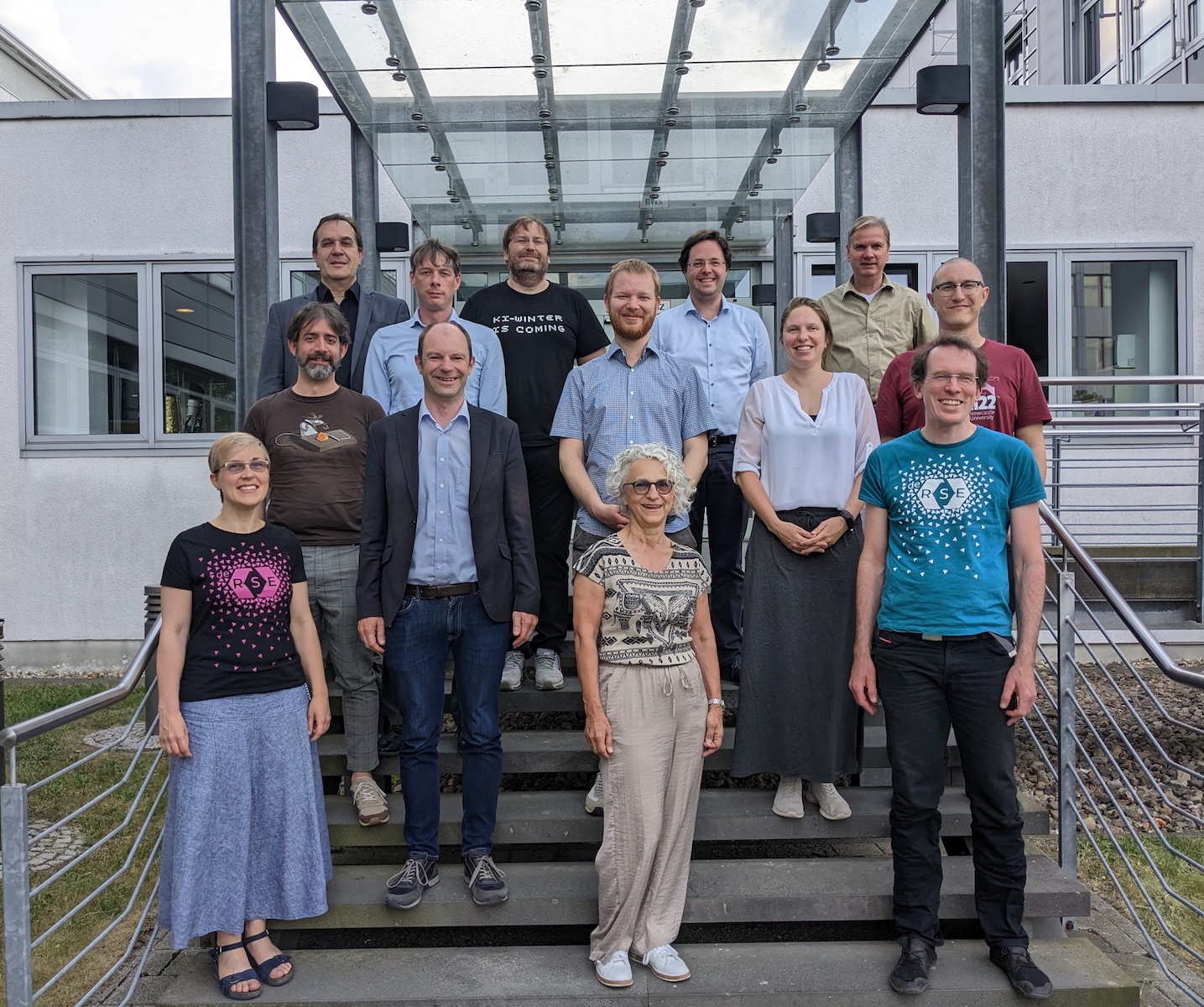
<p>For the last two days of the work year 2025, the <a href="https://github.com/the-teachingRSE-project">teaching RSE working
group</a> of the <a href="https://de-rse.org/de/index.html">deRSE
society</a> met in Dresden for the
<a href="https://the-teachingrse-project.github.io/teachingRSE-symposium/">Symposium on Teaching Research Software Engineering in
Germany</a>.
The journey to Dresden was fairly straight-forward for those coming from Berlin.
Others were not so lucky and arrived a few hours late. The people who
arrived on time used the opportunity to drink coffee and catch up with
various research software engineering topics.</p>

<p>One of the discussions was about why it is so difficult to recruit helpers
and instructors for Carpentries workshops. It seems like the usual
candidates, PhD students, are too busy working in the labs of their
supervisors to be able to do any teaching. In the UK, PhD
students work on their projects which are part of the lab. However, they
are not expected to take on any extra responsibilities in running a lab.
This role is usually fulfilled by post-docs. This might explain why it
appears to be more difficult to establish the carpentries in Germany.</p>

<p><a href="https://www.hzdr.de/db/!ContMan.Visi.Card?pUser=4930&amp;pNid=5">Guido Juckeland</a> gave the first presentation on teaching RSE at the TU
Dresden. The course comprises typical RSE topics: shell, working in
teams, licensing, testing and CI/CD, build systems and software
publications. Teaching is done in lectures and practicals. The students
first work on individual project during the first half and then on group
projects during the second half. They use the
<a href="https://flake8.pycqa.org/en/latest/">flake8</a> python linter for marking.
It was not surprising that genAI popped up. Fredo Erxleben was wondering
how to ensure that the students do not overly rely on genAI for code
generation. They did find that using genAI for test-driven development
worked pretty well since the students have to carefully think about the
tests so that they can prompt the LLM. We came to the conclusion that
you cannot stop people from using genAI. However, they should be made
aware of the various issues and be transparent about their use of the
technology by, for example, making a declaration of AI use. One way to
check that they understand what they did is to ask the students to give
a presentation of their project. The team at the TU Dresden hoped that
the students would produce reproducible jupyter notebooks. In practise,
they stuck to the scaffolding and did not add much documentation.
Students probably need to be guided more explicitly.</p>

<p>Next, <a href="https://orcid.org/0000-0002-5076-4864">Magnus Hagdorn</a> gave a brief overview of the history of the
<a href="https://carpentries.org/">Carpentries</a> and his new role in the <a href="https://software-carpentry.org/about-us/governance/">Software
Carpentry Governance
Committee</a>. Magnus then
gave an outlook of what is brewing in the world of the Carpentries. The
<a href="https://www.hpc-carpentry.org/">HPC Carpentry</a> course has moved into
the incubator and is becoming part of the official curriculum. The
course includes an intro to HPC, workflows with
<a href="https://snakemake.readthedocs.io/en/stable/">snakemake</a> and HPC python.
The course can be easily modified to suit local HPC clusters. The
scientific computing team at the Charité, has used the HPC course during
their last HPC training event. The other big news is that the Carpentries
are working on a two day AI course. In fact, the plan is to have two
courses: one for beginners and one for proficient programmers. Both
courses will include an introduction to the technology of LLMs and how
they work, implications of using them and how to use them at levels
appropriate to the target audience. Magnus also reported on the ideas to work
on the git courses, offering github and gitlab specific material, VSCode
and the plan to look into transitioning courses (in particular
intermediate courses) from the incubator in the Software Carpentry
Programme. During the discussion the <a href="https://coderefinery.github.io/git-intro/">Code Refinery git
course</a> was mentioned and
that they use twitch live streaming for watch parties.</p>

<p>Given the late start, we proceeded to the evening programme: a trip to
the Christmas Market. We passed the big and famous one (the
Striezelmarkt) and went for the one at the Frauenkirche which was a
little bit less crowded. We tried egg glogg which tastes essentially
like alcoholic custard sauce and had something to eat. Some of us
found their way to an inside place with some beer. RSE
discussions continued. We resumed the conversations in the morning at
breakfast in the guest house.</p>

<p>The first talk of the morning was given by
<a href="https://www.hcds.uni-hamburg.de/hcds/team/katrin-schoening-stierand.html">Katrin Schöning-Stierand</a>
from the University of Hamburg. Katrin offers various RSE courses that are
open to members of all faculties. During the winter semester she runs an
introduction to python course and in the summer semester an RSE course.
The RSE course assumes some python knowledge and also includes both
individual and group projects. One problem she struggles with is that
her courses are hard to find because they do not appear in the faculty
course handbooks. At the end of the RSE course the students present
their projects during an RSE day. This helps the students with their
presentation skills and is good advertisement for the courses.</p>

<p>The second talk was given by
<a href="https://www.tu-braunschweig.de/ub/wir-ueber-uns/ansprechpersonen-organigramm/jan-philipp-thiele">Jan Philipp Thiele</a>
from the <a href="https://www.tu-braunschweig.de/struktur/praesidium/vp-dn/digital-science-support-lab">digital science support lab of the TU Braunschweig</a>.
The support services are shared by the various lower saxony universities.
Hannover focuses on AI while Braunschweig focuses on RSE. They use the live code extension
of VSCode with some success. We had an interesting discussion on where
central RSE units could be placed: central IT departments or libraries.
Both deal with information so they are both good candidates. Although
some central IT departments seem to be reluctant to take on extra
services. Other new central RSE units are being established in Marburg
and Frankfurt/Main.</p>

<p>Next was <a href="https://ibots-bonn.de/de/team/nick/">Nicholas Del Grosso</a>
from the university hospital Bonn, who runs the <a href="https://ibots-bonn.de/">iBOTS</a>
open neuroscience training platform which is part of the <a href="https://ibehave.nrw/">ibehave</a> network.
They are a team of four people that develop and teach neuroscience courses. As part of their 
course development pipeline, they evolve their courses through three stages:</p>

<ol>
  <li>tool-based courses, which are essentially howtos,</li>
  <li>courses that teach methods and workflows across an ecosystem of tools, and</li>
  <li>domain specific application courses that address scientific questions, using an ecosystem of tools.</li>
</ol>

<p>The courses take the form of summer schools (2-3 weeks), online workshops
(1-3 days), on-demand help and self-study materials. Their materials and
web site is constructed using a custom pipeline that converts files into
a format ready for the static website generator <a href="https://gohugo.io/">Hugo</a>. They did try
<a href="https://quarto.org/">quarto</a> but found it too slow for such a large project, taking around 30
minutes to generate the entire website, and  using a popular static site generator like Hugo makes customizing
the website with modern features much more straight-forward. Their new pipeline takes seconds to build
the full site. In his talk, Nicholas described RSE services as another part of scientific support infrastructure,
similar to RDM, animal welfare, library service, peer-reviewed journals, etc.
Teaching these courses is
difficult because the trainers are neither domain experts (they support many scientific domains and technical workflows)
nor are they necessarily educators (they tend to have a research background, with no formal education).</p>

<p>There is also a high turnover of staff since either their contracts run out or they find employment elsewhere. This pressurises
course didactics. Without a scaling strategy, most single teachers addressing a group of students can handle a group of 10 to
14 students without trouble. To scale up to larger groups, a course needs to increase the student-student
or student-computer interactions. The iBOTS team does this by having
regular three people break-out rooms. Participants get randomly shuffled
which helps to ensure that preferences to work with either a proficient
or novice practitioner can be satisfied. They also ask that at least one
person shares their screen. This encourages participation and
communication. During the introduction round they ask participants to
tell the others why they are taking part in the course and what they are
excited about which turns out to be much more effective than the teacher
giving a motivational introduction and what to expect and get out of the
course. This way they can handle courses with 80 participants and a
single teacher. Feedback is gathered using following a “4L Retroscpective” session using <a href="https://miro.com/app/dashboard/">Miro</a> boards.
Miro features like Private mode (allows participants to add their own feedback without seeing what the
others are writing) and timers (to keep everyone on-task) are very helpful for this.
In a second round the participants are asked to group the feedback.</p>

<p><a href="https://orcid.org/0000-0001-9265-9619">Julian Dehne</a>, then, gave an update of the development of an
<a href="https://the-teachingrse-project.github.io/RSE-Masters/">RSE Master’s Program</a>. Maja
Toebs has looked at available scientific computing/RSE course
descriptions and is extracting and clustering topics. There is a plan to
pilot various courses during the next year. We had a discussion on
whether generic RSEs are employable and what you can expect from them.
We expect that a RSE can help break silos and build bridges between the
various strands of research endeavours.</p>

<p>Finally, <a href="https://www.physik.uni-wuerzburg.de/tp1/team/postdocs/dr-florian-goth/">Florian Goth</a>
introduced the <a href="https://www.discorse.de">DiscoRSE</a>
project which aims to make RSE related open educational resources more
findable. In order to be able to do so they are looking into a metadata
schema for standardised annotation of RSE-OERs.</p>

<p>All participants agreed, that it was good to
catch up in person after meeting every week virtually in the <a href="https://pad.gwdg.de/s/pVBQ3Sh7Z">online meetings</a>
of the <a href="https://github.com/the-teachingRSE-project">teachingRSE project</a>.
The next opportunity to catch up in person is
the <a href="https://events.hifis.net/event/2945/">deRSE26</a> conference in
Stuttgart.
Presentations of the event will be shared on the
<a href="https://zenodo.org/communities/teachingrse-symposium-2025/records">zenodo community</a>.
We are thankful to the cluster of excellence <a href="https://www.ctdqmat.de/">ctd.qmat</a> for travel support.</p>

<p>This blog post is adapted with friendly permission from <a href="https://magi.marsupium.org/2025/12/2025-teaching-rse-symposium.html">Magnus Hagdorn’s blog</a>.</p>]]></content><author><name>The TeachingRSE collaboration</name></author><summary type="html"><![CDATA[(Picture: By Magnus Hagdorn, CC-BY-SA License) For the last two days of the work year 2025, the teaching RSE working group of the deRSE society met in Dresden for the Symposium on Teaching Research Software Engineering in Germany. The journey to Dresden was fairly straight-forward for those coming from Berlin. Others were not so lucky and arrived a few hours late. The people who arrived on time used the opportunity to drink coffee and catch up with various research software engineering topics. One of the discussions was about why it is so difficult to recruit helpers and instructors for Carpentries workshops. It seems like the usual candidates, PhD students, are too busy working in the labs of their supervisors to be able to do any teaching. In the UK, PhD students work on their projects which are part of the lab. However, they are not expected to take on any extra responsibilities in running a lab. This role is usually fulfilled by post-docs. This might explain why it appears to be more difficult to establish the carpentries in Germany. Guido Juckeland gave the first presentation on teaching RSE at the TU Dresden. The course comprises typical RSE topics: shell, working in teams, licensing, testing and CI/CD, build systems and software publications. Teaching is done in lectures and practicals. The students first work on individual project during the first half and then on group projects during the second half. They use the flake8 python linter for marking. It was not surprising that genAI popped up. Fredo Erxleben was wondering how to ensure that the students do not overly rely on genAI for code generation. They did find that using genAI for test-driven development worked pretty well since the students have to carefully think about the tests so that they can prompt the LLM. We came to the conclusion that you cannot stop people from using genAI. However, they should be made aware of the various issues and be transparent about their use of the technology by, for example, making a declaration of AI use. One way to check that they understand what they did is to ask the students to give a presentation of their project. The team at the TU Dresden hoped that the students would produce reproducible jupyter notebooks. In practise, they stuck to the scaffolding and did not add much documentation. Students probably need to be guided more explicitly. Next, Magnus Hagdorn gave a brief overview of the history of the Carpentries and his new role in the Software Carpentry Governance Committee. Magnus then gave an outlook of what is brewing in the world of the Carpentries. The HPC Carpentry course has moved into the incubator and is becoming part of the official curriculum. The course includes an intro to HPC, workflows with snakemake and HPC python. The course can be easily modified to suit local HPC clusters. The scientific computing team at the Charité, has used the HPC course during their last HPC training event. The other big news is that the Carpentries are working on a two day AI course. In fact, the plan is to have two courses: one for beginners and one for proficient programmers. Both courses will include an introduction to the technology of LLMs and how they work, implications of using them and how to use them at levels appropriate to the target audience. Magnus also reported on the ideas to work on the git courses, offering github and gitlab specific material, VSCode and the plan to look into transitioning courses (in particular intermediate courses) from the incubator in the Software Carpentry Programme. During the discussion the Code Refinery git course was mentioned and that they use twitch live streaming for watch parties. Given the late start, we proceeded to the evening programme: a trip to the Christmas Market. We passed the big and famous one (the Striezelmarkt) and went for the one at the Frauenkirche which was a little bit less crowded. We tried egg glogg which tastes essentially like alcoholic custard sauce and had something to eat. Some of us found their way to an inside place with some beer. RSE discussions continued. We resumed the conversations in the morning at breakfast in the guest house. The first talk of the morning was given by Katrin Schöning-Stierand from the University of Hamburg. Katrin offers various RSE courses that are open to members of all faculties. During the winter semester she runs an introduction to python course and in the summer semester an RSE course. The RSE course assumes some python knowledge and also includes both individual and group projects. One problem she struggles with is that her courses are hard to find because they do not appear in the faculty course handbooks. At the end of the RSE course the students present their projects during an RSE day. This helps the students with their presentation skills and is good advertisement for the courses. The second talk was given by Jan Philipp Thiele from the digital science support lab of the TU Braunschweig. The support services are shared by the various lower saxony universities. Hannover focuses on AI while Braunschweig focuses on RSE. They use the live code extension of VSCode with some success. We had an interesting discussion on where central RSE units could be placed: central IT departments or libraries. Both deal with information so they are both good candidates. Although some central IT departments seem to be reluctant to take on extra services. Other new central RSE units are being established in Marburg and Frankfurt/Main. Next was Nicholas Del Grosso from the university hospital Bonn, who runs the iBOTS open neuroscience training platform which is part of the ibehave network. They are a team of four people that develop and teach neuroscience courses. As part of their course development pipeline, they evolve their courses through three stages: tool-based courses, which are essentially howtos, courses that teach methods and workflows across an ecosystem of tools, and domain specific application courses that address scientific questions, using an ecosystem of tools. The courses take the form of summer schools (2-3 weeks), online workshops (1-3 days), on-demand help and self-study materials. Their materials and web site is constructed using a custom pipeline that converts files into a format ready for the static website generator Hugo. They did try quarto but found it too slow for such a large project, taking around 30 minutes to generate the entire website, and using a popular static site generator like Hugo makes customizing the website with modern features much more straight-forward. Their new pipeline takes seconds to build the full site. In his talk, Nicholas described RSE services as another part of scientific support infrastructure, similar to RDM, animal welfare, library service, peer-reviewed journals, etc. Teaching these courses is difficult because the trainers are neither domain experts (they support many scientific domains and technical workflows) nor are they necessarily educators (they tend to have a research background, with no formal education). There is also a high turnover of staff since either their contracts run out or they find employment elsewhere. This pressurises course didactics. Without a scaling strategy, most single teachers addressing a group of students can handle a group of 10 to 14 students without trouble. To scale up to larger groups, a course needs to increase the student-student or student-computer interactions. The iBOTS team does this by having regular three people break-out rooms. Participants get randomly shuffled which helps to ensure that preferences to work with either a proficient or novice practitioner can be satisfied. They also ask that at least one person shares their screen. This encourages participation and communication. During the introduction round they ask participants to tell the others why they are taking part in the course and what they are excited about which turns out to be much more effective than the teacher giving a motivational introduction and what to expect and get out of the course. This way they can handle courses with 80 participants and a single teacher. Feedback is gathered using following a “4L Retroscpective” session using Miro boards. Miro features like Private mode (allows participants to add their own feedback without seeing what the others are writing) and timers (to keep everyone on-task) are very helpful for this. In a second round the participants are asked to group the feedback. Julian Dehne, then, gave an update of the development of an RSE Master’s Program. Maja Toebs has looked at available scientific computing/RSE course descriptions and is extracting and clustering topics. There is a plan to pilot various courses during the next year. We had a discussion on whether generic RSEs are employable and what you can expect from them. We expect that a RSE can help break silos and build bridges between the various strands of research endeavours. Finally, Florian Goth introduced the DiscoRSE project which aims to make RSE related open educational resources more findable. In order to be able to do so they are looking into a metadata schema for standardised annotation of RSE-OERs. All participants agreed, that it was good to catch up in person after meeting every week virtually in the online meetings of the teachingRSE project. The next opportunity to catch up in person is the deRSE26 conference in Stuttgart. Presentations of the event will be shared on the zenodo community. We are thankful to the cluster of excellence ctd.qmat for travel support. This blog post is adapted with friendly permission from Magnus Hagdorn’s blog.]]></summary></entry><entry><title type="html">Call for Contribution - deRSE26 the RSE Conference 2026 in Germany</title><link href="https://de-rse.org/blog/2025/09/22/deRSE26-call-for-contribution.html" rel="alternate" type="text/html" title="Call for Contribution - deRSE26 the RSE Conference 2026 in Germany" /><published>2025-09-22T00:00:00+02:00</published><updated>2025-09-22T00:00:00+02:00</updated><id>https://de-rse.org/blog/2025/09/22/deRSE26-call-for-contribution</id><content type="html" xml:base="https://de-rse.org/blog/2025/09/22/deRSE26-call-for-contribution.html"><![CDATA[<p>We’re delighted to announce 
that <a href="https://events.hifis.net/event/2945/">deRSE26, the 6th conference for Research Software Engineering in Germany</a>, will be 
hosted at the University of Stuttgart from the 3rd to the 5th March 2026.</p>

<p>The <a href="https://events.hifis.net/event/2945/abstracts/">call for contributions</a> will open on September 22. 
We encourage you to submit an abstract, whether you are from academia or industry, a student or an employee, a first-time presenter or a seasoned RSE. 
If your contribution addresses a topic that you think is of interest to the community of people concerned with research software, we would love to see it submitted!</p>

<p>We use the Indico platform to manage conference registration and abstract submission. These operations are decoupled from each other, i.e. abstract submission doesn’t automatically register you. You can use Helmholtz AAI to create an account through your institution, GitHub, Google, or ORCID.</p>

<p>We plan to publish a post-conference proceedings volume on the deRSE26 conference. Contributors to deRSE26 will be invited to submit a journal-length version of their contribution to this volume after the conference. Submissions will be peer-reviewed and, if accepted, published in the open-access journal ECEASST (https://eceasst.org/index.php/eceasst) at no cost to the authors.</p>

<p>Please don’t hesitate to contact the orga team, derse26@listserv.dfn.de, if you have any questions.</p>

<p>We are looking forward to welcoming you in Stuttgart next March!</p>]]></content><author><name>Stephan Janosch in behalf the deRSE26 organisers</name></author><summary type="html"><![CDATA[We’re delighted to announce that deRSE26, the 6th conference for Research Software Engineering in Germany, will be hosted at the University of Stuttgart from the 3rd to the 5th March 2026. The call for contributions will open on September 22. We encourage you to submit an abstract, whether you are from academia or industry, a student or an employee, a first-time presenter or a seasoned RSE. If your contribution addresses a topic that you think is of interest to the community of people concerned with research software, we would love to see it submitted! We use the Indico platform to manage conference registration and abstract submission. These operations are decoupled from each other, i.e. abstract submission doesn’t automatically register you. You can use Helmholtz AAI to create an account through your institution, GitHub, Google, or ORCID. We plan to publish a post-conference proceedings volume on the deRSE26 conference. Contributors to deRSE26 will be invited to submit a journal-length version of their contribution to this volume after the conference. Submissions will be peer-reviewed and, if accepted, published in the open-access journal ECEASST (https://eceasst.org/index.php/eceasst) at no cost to the authors. Please don’t hesitate to contact the orga team, derse26@listserv.dfn.de, if you have any questions. We are looking forward to welcoming you in Stuttgart next March!]]></summary></entry><entry><title type="html">GI- und DE-RSE Muster-Leitlinie zur effizienten Entwicklung von Forschungssoftware veröffentlicht</title><link href="https://de-rse.org/blog/2025/02/11/musterleitlinie.html" rel="alternate" type="text/html" title="GI- und DE-RSE Muster-Leitlinie zur effizienten Entwicklung von Forschungssoftware veröffentlicht" /><published>2025-02-11T00:00:00+01:00</published><updated>2025-02-11T00:00:00+01:00</updated><id>https://de-rse.org/blog/2025/02/11/musterleitlinie</id><content type="html" xml:base="https://de-rse.org/blog/2025/02/11/musterleitlinie.html"><![CDATA[<p>Der von de-RSE und der Fachgruppe RSE der GI gemeinsam geführte Arbeitskreis “RSE Software Development Guideline” hat eine Musterleitlinie “GI- und DE-RSE Muster-Leitlinie zur effizienten Entwicklung von Forschungssoftware” erarbeitet und veröffentlicht. Die Musterleitlinie ist nunmehr verfügbar unter <a href="https://doi.org/10.18420/2025-gi_de-rse">https://doi.org/10.18420/2025-gi_de-rse</a>.</p>

<p><img src="/assets/img/blog/2025/csm_2025-cover-gi-derse-leitlinien.png" alt="" width="400px" /></p>]]></content><author><name>Arbeitskreis - RSE Software Development Guideline</name></author><summary type="html"><![CDATA[Der von de-RSE und der Fachgruppe RSE der GI gemeinsam geführte Arbeitskreis “RSE Software Development Guideline” hat eine Musterleitlinie “GI- und DE-RSE Muster-Leitlinie zur effizienten Entwicklung von Forschungssoftware” erarbeitet und veröffentlicht. Die Musterleitlinie ist nunmehr verfügbar unter https://doi.org/10.18420/2025-gi_de-rse.]]></summary></entry><entry><title type="html">Klaus Tschira Stiftung fördert de-RSE im Projekt FutuRSI</title><link href="https://de-rse.org/blog/2025/01/20/kts_foerderung.html" rel="alternate" type="text/html" title="Klaus Tschira Stiftung fördert de-RSE im Projekt FutuRSI" /><published>2025-01-20T00:00:00+01:00</published><updated>2025-01-20T00:00:00+01:00</updated><id>https://de-rse.org/blog/2025/01/20/kts_foerderung</id><content type="html" xml:base="https://de-rse.org/blog/2025/01/20/kts_foerderung.html"><![CDATA[<p>Die <a href="https://klaus-tschira-stiftung.de/foerderungen/naturwissenschaftliche-software/">Ausschreibung</a> der <a href="https://klaus-tschira-stiftung.de/">Klaus Tschira Stiftung</a> zum Thema „Software in der naturwissenschaftlichen Forschung“ endete im Mai 2024.
Einige Mitglieder von de-RSE konnten mit ihren Projektideen die Stiftung überzeugen.</p>

<p>Dazu zählt das Projekt „FutuRSI: Konzeption und Anlaufphase eines deutschen Forschungssoftware-Instituts“.
Es hat zum Ziel, eine prototypische Service-Organisation für Research Software Engineering mit verteilten Teams für ein bundesweites,
föderales Angebot zu entwickeln. Dabei werden die gewonnenen Erfahrungen genutzt, um ein Konzept für die einzelnen Arbeitsschritte zu erstellen, die für den prototypischen Aufbau einer deutschlandweiten Organisation notwendig sind.
Um dieses Ziel zu erreichen, werden die Entwicklung der Struktur bottom-up und iterativ gestaltet und Stakeholder aus Wissenschaft und Politik frühzeitig und kontinuierlich eingebunden.
Teil des Konzepts ist auch eine Machbarkeitsstudie und ein Vorschlag für eine Organisationsstruktur.
Das FutuRSI-Projekt wird von einem Konsortium aus sechs Institutionen in Deutschland durchgeführt und startet im April 2025.
Neben dem de-RSE Verein sind auch das Forschungszentrum Jülich (FZJ), die Gesellschaft für Informatik (GI), das Helmholtzzentrum Dresden Rossendorf (HZDR), das Kompetenzzentrum Digitale Forschung (zedif) der Universität Jena und die SUB Göttingen an dem Projekt beteiligt.</p>

<p>In Kooperation des de-RSE Vereins mit der Fachgruppe RSE der GI sind zudem zwei weitere erfolgreiche Projektanträge entstanden.
Eines der Projekte zielt darauf ab, ein RSE Master-Programm zu entwickeln, während das andere dem Thema “Award” im RSE Kontext gewidmet ist.
Der Antrag “Ausgezeichnete Forschungssoftware (RSE-Award)” verfolgt das Ziel, die Qualität und Sichtbarkeit von Forschungssoftware durch einen RSE-Award zu fördern.
Die Auszeichnung soll Anreize für qualitativ hochwertige Softwareentwicklung schaffen, Best Practices hervorheben und die RSE-Community stärken.
Das Projekt “Research Software Engineering Master” zielt wiederum darauf ab, einen spezialisierten Masterstudiengang für Research Software Engineering (RSE) zu entwickeln.
Es soll ein Referenz-Curriculum erstellt, in bestehenden Studiengängen erprobt und langfristig zur Etablierung offizieller RSE-Abschlüsse genutzt werden.
Das Projekt wird u.a. in enger Kooperation mit dem gemeinsamen Arbeitskreis “Teaching RSE” von de-RSE und GI durchgeführt.</p>

<p>Wir freuen uns auf die Zusammenarbeit mit allen Beteiligten.</p>]]></content><author><name>Michael Meinel, Jan Linxweiler</name></author><summary type="html"><![CDATA[Die Ausschreibung der Klaus Tschira Stiftung zum Thema „Software in der naturwissenschaftlichen Forschung“ endete im Mai 2024. Einige Mitglieder von de-RSE konnten mit ihren Projektideen die Stiftung überzeugen. Dazu zählt das Projekt „FutuRSI: Konzeption und Anlaufphase eines deutschen Forschungssoftware-Instituts“. Es hat zum Ziel, eine prototypische Service-Organisation für Research Software Engineering mit verteilten Teams für ein bundesweites, föderales Angebot zu entwickeln. Dabei werden die gewonnenen Erfahrungen genutzt, um ein Konzept für die einzelnen Arbeitsschritte zu erstellen, die für den prototypischen Aufbau einer deutschlandweiten Organisation notwendig sind. Um dieses Ziel zu erreichen, werden die Entwicklung der Struktur bottom-up und iterativ gestaltet und Stakeholder aus Wissenschaft und Politik frühzeitig und kontinuierlich eingebunden. Teil des Konzepts ist auch eine Machbarkeitsstudie und ein Vorschlag für eine Organisationsstruktur. Das FutuRSI-Projekt wird von einem Konsortium aus sechs Institutionen in Deutschland durchgeführt und startet im April 2025. Neben dem de-RSE Verein sind auch das Forschungszentrum Jülich (FZJ), die Gesellschaft für Informatik (GI), das Helmholtzzentrum Dresden Rossendorf (HZDR), das Kompetenzzentrum Digitale Forschung (zedif) der Universität Jena und die SUB Göttingen an dem Projekt beteiligt. In Kooperation des de-RSE Vereins mit der Fachgruppe RSE der GI sind zudem zwei weitere erfolgreiche Projektanträge entstanden. Eines der Projekte zielt darauf ab, ein RSE Master-Programm zu entwickeln, während das andere dem Thema “Award” im RSE Kontext gewidmet ist. Der Antrag “Ausgezeichnete Forschungssoftware (RSE-Award)” verfolgt das Ziel, die Qualität und Sichtbarkeit von Forschungssoftware durch einen RSE-Award zu fördern. Die Auszeichnung soll Anreize für qualitativ hochwertige Softwareentwicklung schaffen, Best Practices hervorheben und die RSE-Community stärken. Das Projekt “Research Software Engineering Master” zielt wiederum darauf ab, einen spezialisierten Masterstudiengang für Research Software Engineering (RSE) zu entwickeln. Es soll ein Referenz-Curriculum erstellt, in bestehenden Studiengängen erprobt und langfristig zur Etablierung offizieller RSE-Abschlüsse genutzt werden. Das Projekt wird u.a. in enger Kooperation mit dem gemeinsamen Arbeitskreis “Teaching RSE” von de-RSE und GI durchgeführt. Wir freuen uns auf die Zusammenarbeit mit allen Beteiligten.]]></summary></entry><entry><title type="html">Code for science - Themenwoche VW Stiftung</title><link href="https://de-rse.org/blog/2024/12/05/vw-symposium.html" rel="alternate" type="text/html" title="Code for science - Themenwoche VW Stiftung" /><published>2024-12-05T00:00:00+01:00</published><updated>2024-12-05T00:00:00+01:00</updated><id>https://de-rse.org/blog/2024/12/05/vw-symposium</id><content type="html" xml:base="https://de-rse.org/blog/2024/12/05/vw-symposium.html"><![CDATA[<p><img src="/assets/img/blog/2024/2024-12-04_RSE-Symposium_Hannover_Gruppenfoto.jpg" alt="" width="800px" /></p>

<p>Unter dem Dach der Themenwoche “Digitale Kompetenzen in der Wissenschaft” förderte die VW-Stiftung<br />
vom 02.-04.12.2024 vier Symposien mit Raum für den gegenseitigen Austausch. Die Teilnehmer:innen unseres 
Symposiums “Code for Science, oder: Bessere Forschungssoftware durch bessere Forschungssoftwarekompetenzen” 
kamen nicht nur aus dem RSE-Umfeld, sondern auch von Bibliotheken, Rechenzentren und aus dem Forschungsdatenmanagement. 
In drei intensiven Tagen konnten wir Ideen zusammentragen, wie die Kompetenzen im Bereich 
Forschungssoftware verbessert werden können, und welche guten Initiativen es in diesem Feld bereits gibt. 
Wir haben ein Dokument mit Handlungsempfehlungen für verschiedene Akteure begonnen zu entwickeln. 
Demnächst werden wir an dieser Stelle mehr davon berichten - bleibt dran!</p>]]></content><author><name>Bernadette Fritzsch, Dominic Kempf, Jan Linxweiler, Yves Vincent Grossmann, Frank Löffler</name></author><summary type="html"><![CDATA[Unter dem Dach der Themenwoche “Digitale Kompetenzen in der Wissenschaft” förderte die VW-Stiftung vom 02.-04.12.2024 vier Symposien mit Raum für den gegenseitigen Austausch. Die Teilnehmer:innen unseres Symposiums “Code for Science, oder: Bessere Forschungssoftware durch bessere Forschungssoftwarekompetenzen” kamen nicht nur aus dem RSE-Umfeld, sondern auch von Bibliotheken, Rechenzentren und aus dem Forschungsdatenmanagement. In drei intensiven Tagen konnten wir Ideen zusammentragen, wie die Kompetenzen im Bereich Forschungssoftware verbessert werden können, und welche guten Initiativen es in diesem Feld bereits gibt. Wir haben ein Dokument mit Handlungsempfehlungen für verschiedene Akteure begonnen zu entwickeln. Demnächst werden wir an dieser Stelle mehr davon berichten - bleibt dran!]]></summary></entry></feed>