AI for Research: Governance and Infrastructure — RSE Day 2026
Carolin Odebrecht, Stephan Druskat, Johannes Schäffer, October 1, 2026
The disruptive impact of generative Artificial Intelligence (GenAI) systems and methods concerns all research areas and disciplines, as well as many roles within research, albeit in different ways. In general, research conducted using AI tools introduces new responsibilities, relies on new social and technical infrastructure, and requires new skills and competencies.
Responsibilities
Research conducted using GenAI requires stakeholders to evaluate new — and re-evaluate existing — requirements on research ethics and integrity, legal requirements and IT security. Where research software and data outputs become (critical) research infrastructure and related services are being provided, researchers may become accountable as service providers, in addition to their responsibilities as software developers and data creators. Despite this, roles such as Research Software Engineers are often overlooked in discussions around responsibility profiles, as well as requirements for regulation and (research) infrastructure, in the context of GenAI in research. This means that the scholars who actually develop, adopt or fine-tune such systems do not get to share their first-hand experience, provide practical insights and influence the policies that will govern their work in this area. The workshop “AI Research Governance. Responsibility, regulation and guidelines in context of research developments”, conducted by Carolin Odebrecht at the first Research Software Day Berlin & Brandenburg [7], therefore aimed to open discussions around governance of GenAI in research to research software engineers, whose specific expertise makes them an important part of the social infrastructure required for GenAI in research.
Social infrastructure
Just like other computational work, the adoption of GenAI in and for research needs to be cross-functional and inter-disciplinary, and requires the close collaboration of individual research teams with many stakeholders, such as other research groups, computing centers, libraries and central RSE groups, all of which may be located within a team’s organizational unit or institution, or outside of it. These collaborations need to be coordinated and often formalized. In contrast to well- or better-established scenarios such as research data, research software, and the collaboration on and sharing or provision of these digital research outputs, there are still only few experiences and good practices established for collaboration between stakeholders on GenAI-related activities, policies, ethics and strategies.
Technical infrastructure
Similarly, the design, development and use of technical infrastructure, such as hardware, AI-as-a-Service, and computational capacities for pre-training, fine-tuning, instruction, inference, etc., requires new models for collaboration and identification of responsibilities. These need to be developed in academic organizations with the participation of researchers. Some fundamental questions in this area include: Which technical infrastructure is needed for our research life cycles? Can we build on existing internal or external infrastructure? How do we design the FAIR and CAREful access and use of technical infrastructure? How do we measure, and account for, the cost and ecological impact of GenAI?
An AI governance therefore should cover the different social and technical infrastructures. In general, AI governance is defined commonly as a
[…] a system of rules, practices, processes, and technological tools that are employed to ensure an organization’s use of AI technologies aligns with the organization’s strategies, objectives, and values; fulfills legal requirements; and meets principles of ethical AI followed by the organization. [9, p. 604]
Research organizations need to develop and implement a governance framework that clarifies the responsibilities and accountability with regard to the adoption and use of GenAI, and provides guidelines and guardrails with respect to the technical and social infrastructure required to support it. This framework must be operationalized through, e.g., guidelines and policies targeting all relevant roles, job descriptions and staff planning in research and administration, and IT infrastructure strategies that safeguard independence from proprietary solutions, avoid vendor lock-in, and support digital sovereignty in research. Importantly, the development of governance frameworks should be participatory, in that the process must include all relevant users, producers, providers and other stakeholders, including RSEs.
Figure 1: Focal points for AI Governance in research contexts; purple: research cycles and workflows; yellow: people; pink: organisational infrastructure; green: organisation with goals and existing governance; petrol: external regulation.
AI governance systems should therefore:
-
inform about relevant aspects in terms of and ethical, legal and research integrity requirements, as well as IT security;
-
establish references to stages and objects of research life cycles (and/or teaching) across disciplines and roles;
-
define the scope of accountability and responsibilities of researchers, digital research technical professionals (dRTPs), other staff, and the organization as such;
-
define and implement corresponding social and technical (research) infrastructures that supports researchers with regard to points (1)–(3).
Raising awareness and fostering collaboration
To raise awareness of the importance of AI governance for research, and the lack of inclusion and participation of RSEs and other dRTPs in their development and implementation, Carolin Odebrecht ran the workshop “AI Research Governance. Responsibility, regulation and guidelines in context of research developments” at the Research Software Day Berlin & Brandenburg 2026 on 3 June 2026.
Participation from RSEs and researchers from biology, computer science, physics, chemistry, digital humanities, earth sciences, economics, sociology, life sciences, as well as dRTPs from museums and further interdisciplinary backgrounds clearly showed the cross-disciplinary relevance of the topic. For introduction, Carolin Odebrecht had prepared an input on (AI) governance that served as the basis for our discussion throughout the workshop. The session was enriched with interactive elements using a feedback app (Particify [1]).
As not everyone in the room had a definition of the term ‘governance’ to hand, the introductory presentation began with a definition: Governance is the framework by which an organization is controlled, and how decisions are being made within the organization [2]. Importantly for the context of the work presented in this blog post, governance is also a tool to transfer external requirements — such as laid out by law or funding requirements - into an organization’s internal context, making them actionable.
Using Particify, we discussed our (the participants’) backgrounds and contexts — especially the roles we hold in our respective organizations and whether we were aware of guidelines for AI use. As AI guidelines are currently developed at many organisations, only half of the participants stated that they are aware of an AI guideline. Surprisingly, a third was not sure whether such guidelines exist at their organisation. This points to a general discussion about responsibility profiles: whose responsibility covers the dissemination and implementation of such guidelines? In more depth, we collected our multiple roles via Particify and discussed them (Fig. 2).
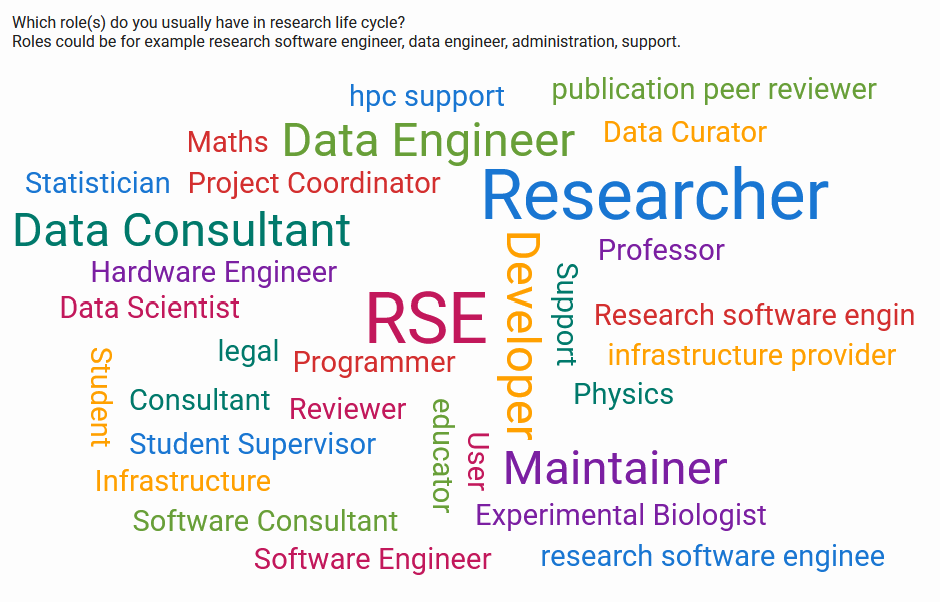
Figure 2: Participants' roles in interdisciplinary research fields show a wide range of responsibility areas and functions. The roles were collected via Particify.
Participants mentioned unclear responsibilities, i.e. the ambiguity regarding who in an organization should take the lead in implementing AI governance. Among others the following question came up: If everything is already addressed in legal frameworks, what is the need for a governance framework? Additionally, the lack of visible, immediate benefits of implementing AI governance made it difficult to justify the effort of defining a governance framework. Another point that was mentioned was the fear of limiting oneself (or the organization), and missing out on the opportunities that AI may provide. On the ethical level, some argued that the moral integrity implied in guidelines for good scientific practice alone - along with the assumption that researchers inherently use AI responsibly - reduced the perceived urgency for formal governance. Subsequently, we explored the potential content for an AI governance document by identifying requirements for AI use in our organizations, covering technical, personnel, and administrative infrastructures (Fig. 3).
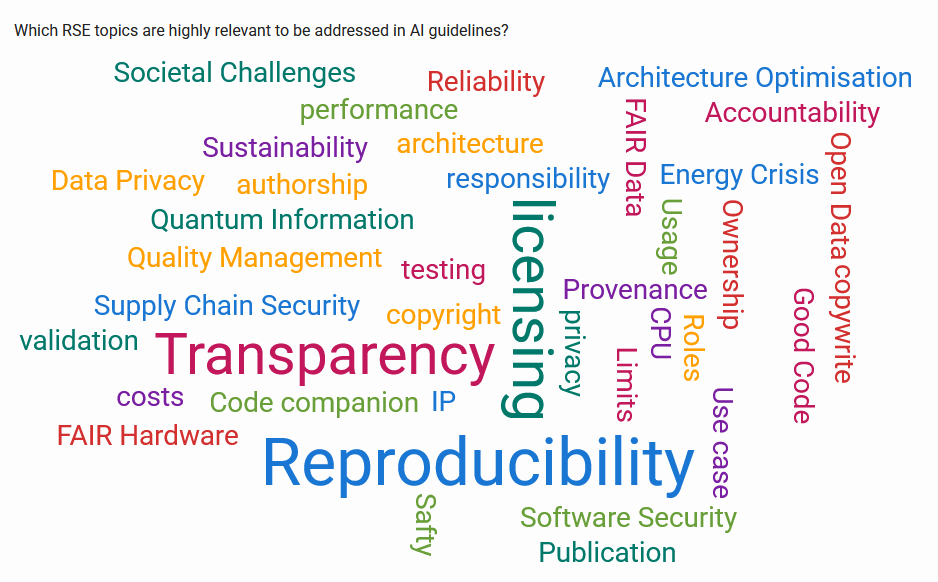
Figure 3:Answers from participants identifying the topics relevant to discuss in the context of AI guidelines.
At the end of our workshop, we discussed multiple (partly hypothetical) challenges and obstacles on the path to developing and adapting AI governance standards.
Related Work
Although AI for research is a broad topic, the specific focus on governance and infrastructure in the context of roles and responsibility areas is currently getting increasing attention, e.g., with the BUA Workshop “AI Policies at Universities: Hands-On Workshop on Guidelines, Implementation, and Open Science” on 2 June 2026 [3], the de-RSE workshop on “AI-supported Research Software Engineering” in September 2026 [4] and the Research Software Alliance’s workshop “Research Software Engineering in the Age of Generative AI: Building a Community Vision” in Edinburgh (UK), March 2026 [10]. The evolution of the RSE role is also discussed in the blog post “Research Software Engineers in the Age of GenAI: Same Value, Changing Practice” [5]. Discussing roles and responsibility areas is not new to RSE contexts, as we also discussed this together with colleagues from King’s College already in June 2025 [8].
Conclusion
GenAI challenges many areas of responsibility and infrastructure - especially for RSE and dRTP in their various roles dealing with genAI directly in their research contexts. We argue that governance and infrastructure are heavily interdependent. There is no living governance without accessible infrastructure. Vice versa, establishing infrastructure without governance risks the creation of responsibility vacuums [6]. Governance and infrastructure that are developed with reference to each other, and specifically to serve the inclusion of GenAI in research life cycles, enable research integrity, sovereignty and therefore independent research. Governance and infrastructure should be developed and adapt in a user-centred way to address the requirements of administrative, social and technical infrastructure mentioned above. However, governance and the development of guidelines or policies is often centred around leadership roles which in turn might risk a gap between researchers needs and leadership’s focal points. Interdisciplinary discussions with researchers fulfilling their responsibility roles is needed to first raise awareness of topics, second to exchange in depth knowledge and experience - literacies exchange for both groups - and third to develop and adapt collaboratively living guidelines that also take infrastructure into account.
Acknowledgements
The authors would like to thank Alexander Struck and Claudia Göbel for organising the RSE Day 2026 in Berlin! This contribution was created in the context of the Interdisciplinary Centre for Digitality and Digital Methods Campus Mitte, Humboldt-Universität zu Berlin. SD’s work was supported by the Lower Saxony Digital Science Support Space (DS³) project as part of Hochschule.digital Niedersachsen, funded by zukunft.niedersachsen.
References
- [1] Anon. [n. d.]. Particify. Particify GmbH. https://www.particify.de/en/
- [2] Arthur Benz, Susanne Lütz, Uwe Schimank, and Georg Simonis (Eds.). 2007. Handbuch Governance. VS Verlag für Sozialwissenschaften. doi:10.1007/978-3-531-90407-8
- [3] Berlin University Alliance. 2026. KI-Policies an Hochschulen: Praxisworkshop zu Leitlinien, Umsetzung und Open Science. https://www.berlin-university-alliance.de/commitments/research-quality/events/2026/20260602-ki-os-policies.html
- [4] de-RSE – Gesellschaft für Forschungssoftware. 2026. De-RSE Collaboration + AI in RSE Workshop in Germany 2026. https://events.hifis.net/event/3249/page/968-workshop-on-ai-supported-research-software-engineering
- [5] Stephan Druskat, Michelle Barker, Ian Cosden, Cunliang Geng, Robert Haines, Daniel S. Katz, Joseph Shingleton, and Ben van Werkhoven. 2026. Research Software Engineers in the Age of GenAI: Same Value, Changing Practice. Technical Report. Zenodo. doi:10.5281/zenodo.20320179
- [6] Jo Freeman. 1972. The Tyranny of Stuctureless. https://www.jofreeman.com/joreen/tyranny.htm
- [7] Claudia Göbel and Alexander Struck. 2026. First Research Software Day Berlin & Brandenburg, 3 June 2026. https://forschungssoftware.info/RSdays/2026/Berlin/
- [8] Henrik Schönemann. 2025. Retrospect: RSE Networking Event June 24th/25th. https://izd2m.hu-berlin.de/blog-posts/2025/09/02/bp-rse-network-event.html
- [9] Matti Mäntymäki, Matti Minkkinen, Teemu Birkstedt, and Mika Viljanen. 2022. Defining Organizational AI Governance. AI and Ethics 2, 4 (Nov. 2022), 603–609. doi:10.1007/s43681-022-00143-x
- [10] Research Software Alliance. 2025. Research Software Engineering in the Age of Generative AI: Building a Community Vision. https://www.researchsoft.org/events/rse-ai-workshop/

